How Marketer MCP Extends SitecoreAI Beyond the UI
Introduction
Artificial intelligence inside digital experience platforms is evolving quickly. Most AI-powered marketing tools focus heavily on user interfaces, dashboards, and workflows designed for marketers. While those interfaces are valuable, modern marketing operations increasingly require AI to work beyond the browser.
That is where Marketer MCP changes the conversation.
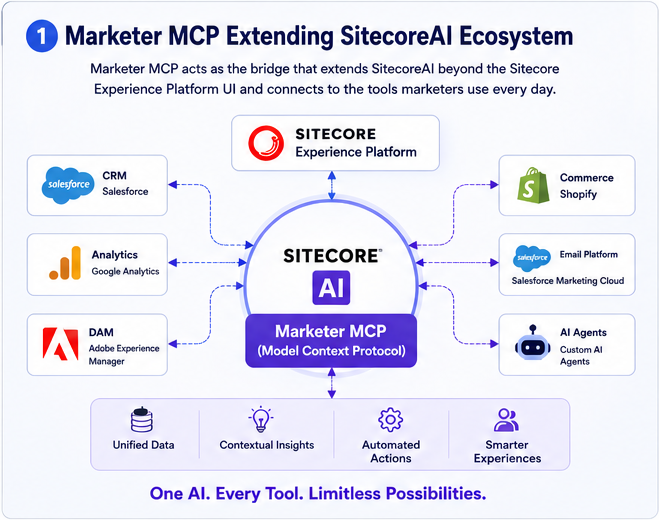
Marketer MCP extends SitecoreAI’s capabilities beyond the traditional UI layer, enabling developers, marketers, and enterprise teams to interact with It programmatically. Instead of limiting AI workflows to predefined screens and manual actions, Marketer MCP bridges SitecoreAI to external systems, automation pipelines, AI agents, developer tools, and custom business workflows.
This shift matters because enterprise marketing today is no longer confined to a single platform. Teams operate across CRMs, analytics systems, DAM platforms, content hubs, commerce engines, customer support tools, and AI copilots. Marketer MCP helps SitecoreAI become part of that broader ecosystem.
What Is Marketer MCP?
Marketer MCP is a framework or integration layer that allows SitecoreAI functionality to be exposed and consumed outside the native Sitecore UI experience.
At its core, MCP acts as an orchestration and communication mechanism that enables external systems, automation tools, AI agents, and developers to interact with SitecoreAI capabilities through structured interfaces.
Instead of requiring a marketer to manually:
- Open Sitecore
- Navigate to a content workspace
- Launch an AI assistant
- Enter prompts manually
- Copy and paste generated content
- Trigger workflows one-by-one
Marketer MCP allows those actions to happen programmatically.
That means organizations can:
- Automate content generation
- Trigger AI workflows from external systems
- Connect SitecoreAI to enterprise orchestration platforms
- Integrate with custom applications
- Enable AI-driven personalization pipelines
- Use external AI agents with SitecoreAI context
- Build custom marketing copilots
In simple terms, Marketer MCP turns SitecoreAI from a UI-bound assistant into an enterprise AI service layer.
Why Extending Beyond the UI Matters
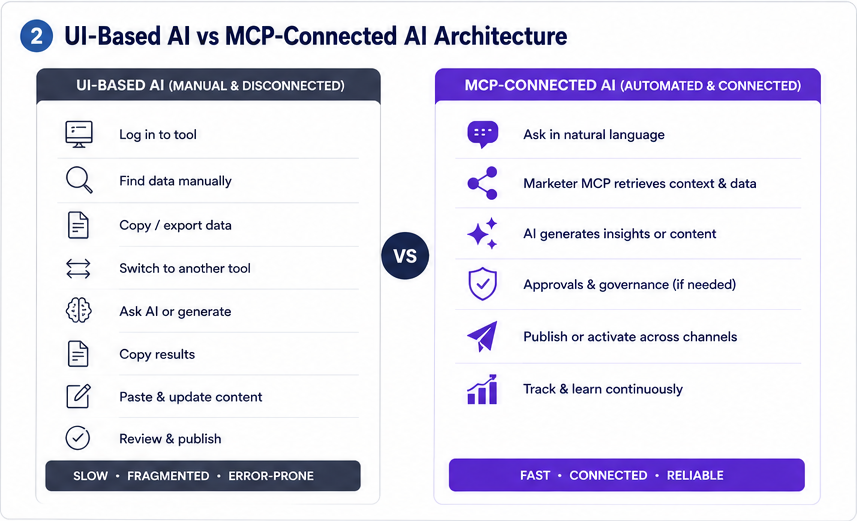
Traditional marketing interfaces are designed for human interaction. They work well when a marketer performs a limited set of actions manually.
However, enterprise-scale marketing requires automation, orchestration, and integration.
Modern marketing organizations need systems that can:
- Respond in real time
- Coordinate across channels
- Generate content dynamically
- Trigger AI workflows automatically
- Personalize experiences at scale
- Connect data sources instantly
- Support autonomous AI processes
A UI alone cannot efficiently support those scenarios.
Marketer MCP addresses this limitation by enabling SitecoreAI to operate as a connected intelligence layer instead of only a user-facing feature.
How Marketer MCP Works
Although implementation details may vary depending on architecture and deployment, the concept generally involves several core components.
1. API and Service Exposure
Marketer MCP exposes SitecoreAI capabilities through APIs, service endpoints, or structured communication protocols.
These interfaces allow external systems to:
- Send prompts
- Request content generation
- Retrieve personalization recommendations
- Execute workflows
- Analyze marketing data
- Trigger campaign operations
This creates machine-to-machine interaction instead of only human-to-UI interaction.
2. Context Sharing
One of the most important aspects of enterprise AI is context.
Marketer MCP allows SitecoreAI to receive contextual information from external systems such as:
- Customer data platforms
- CRM systems
- Commerce platforms
- Analytics engines
- Campaign management tools
- Product catalogs
- Brand governance systems
This improves the quality and relevance of AI outputs.
For example, an external workflow could send:
- Customer segment information
- Product inventory data
- Campaign performance metrics
- Geographic targeting rules
- Brand voice guidelines
SitecoreAI can then generate more intelligent and contextual outputs.
3. Workflow Orchestration
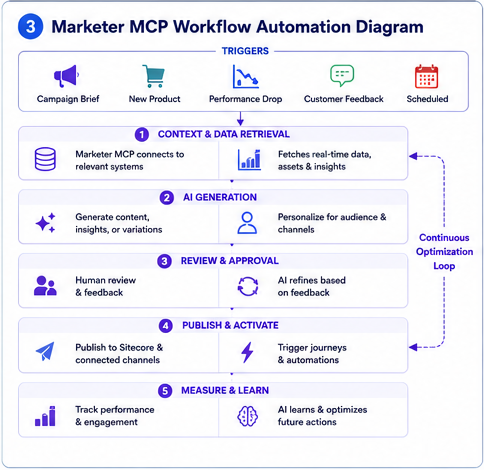
MCP enables AI operations to become part of larger automated workflows.
For example:
- A customer abandons a cart
- Commerce data triggers an automation workflow
- Marketer MCP sends contextual information to SitecoreAI
- SitecoreAI generates personalized email content
- The workflow routes the content for approval
- The campaign launches automatically
This removes multiple layers of manual work.
4. AI Agent Integration
One of the most exciting possibilities is AI agent interoperability.
Marketer MCP can allow external AI agents or copilots to interact with SitecoreAI capabilities.
This means organizations could:
- Build internal marketing copilots
- Use AI coding assistants for content workflows
- Enable conversational campaign management
- Connect enterprise AI assistants to marketing systems
- Automate operational marketing tasks
This creates a much more flexible AI ecosystem.
Key Benefits of Marketer MCP
Increased Automation
Marketing teams spend enormous amounts of time performing repetitive tasks.
Marketer MCP enables automation of:
- Content generation
- Content summaries
- SEO recommendations
- Campaign creation
- Audience segmentation workflows
- Metadata generation
- Product description generation
- Translation workflows
- Approval routing
Automation reduces operational overhead and improves speed.
Faster Content Operations
Content production bottlenecks are common in enterprise environments.
With MCP-enabled workflows, content generation can happen automatically based on:
- Product launches
- Inventory changes
- Campaign schedules
- Market triggers
- Seasonal events
- User behavior
This dramatically accelerates time-to-market.
Better Personalization
SitecoreAI becomes more powerful when connected to live customer and behavioral data.
Marketer MCP enables:
- Real-time personalization
- Dynamic content assembly
- Context-aware messaging
- Cross-channel adaptation
- Behavioral targeting
Instead of static personalization rules, organizations can create adaptive AI-driven experiences.
Reduced UI Dependency
One of the biggest architectural advantages is reducing dependency on manual UI interactions.
This allows:
- Headless workflows
- Background processing
- Event-driven execution
- Autonomous operations
- Integration-first architectures
The result is greater scalability.
Enterprise Flexibility
Every enterprise has unique workflows.
Marketer MCP provides the flexibility to:
- Build custom interfaces
- Connect proprietary systems
- Create specialized AI workflows
- Support internal tools
- Extend SitecoreAI to new channels
This makes SitecoreAI adaptable instead of restrictive.
Real-World Use Cases
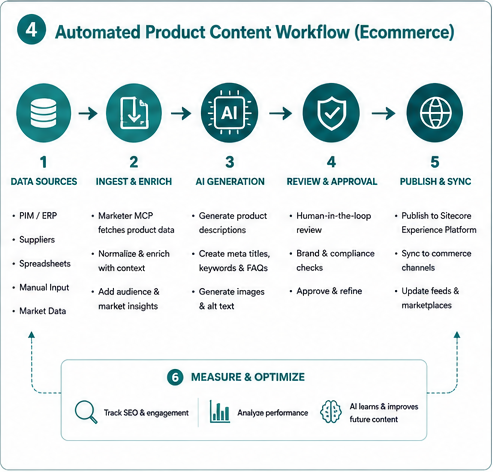
Automated Product Content Generation
An ecommerce company launches thousands of products every month.
Instead of manually creating descriptions:
- Product data enters the commerce system
- An automation workflow triggers MCP
- SitecoreAI generates optimized product copy
- SEO metadata is created automatically
- Content is routed for approval
- Approved content publishes across channels
This reduces manual workload significantly.
Intelligent Campaign Creation
Marketing teams can automate campaign preparation.
For example:
- Analytics identifies declining engagement
- MCP triggers SitecoreAI
- AI generates recovery campaign messaging
- Suggested audience segments are created
- Email variants are generated
- Campaign assets are assembled automatically
Marketers shift from manual execution to strategic oversight.
AI-Powered Support for Content Teams
Editorial teams often work across multiple tools.
With MCP integrations:
- Writers can generate content from Slack, Teams, or custom apps
- Editors can summarize content automatically
- SEO recommendations can appear directly inside workflows
- AI assistance becomes embedded in existing processes
This reduces context switching.
Omnichannel Personalization
Marketer MCP enables personalization across channels.
For example:
- Customer behavior updates in real time
- SitecoreAI receives behavioral context
- Personalized content is generated dynamically
- Messaging adapts across:
- Web
- Mobile
- In-app experiences
- Digital signage
This creates more consistent customer experiences.
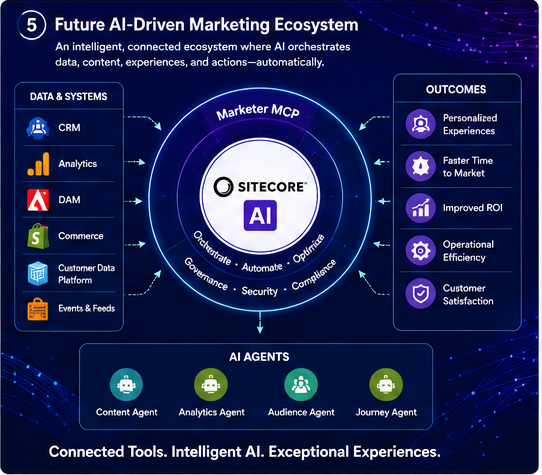
Marketer MCP and the Future of AI-Driven Marketing
The broader significance of Marketer MCP is architectural.
AI platforms are moving away from isolated assistant experiences toward interconnected intelligent systems.
The future of enterprise marketing will likely include:
- AI agents coordinating workflows
- Autonomous campaign optimization
- Event-driven content generation
- AI-powered orchestration layers
- Real-time personalization engines
- Conversational operational interfaces
- Cross-platform AI collaboration
Marketer MCP positions SitecoreAI for that future.
Instead of being limited to a feature inside a CMS interface, SitecoreAI becomes part of a larger enterprise AI operating model.
That distinction is important.
Organizations that treat AI as a standalone feature may gain short-term productivity improvements.
Organizations that integrate AI deeply into operational workflows will gain strategic advantages in speed, personalization, scalability, and efficiency.
Challenges and Considerations
While Marketer MCP introduces significant advantages, organizations should also consider implementation challenges.
Governance
AI-generated content still requires governance.
Teams need:
- Brand guidelines
- Approval workflows
- Compliance validation
- Content auditing
- Human oversight
Security and Permissions
Extending AI capabilities through APIs requires strong security controls.
Organizations should implement:
- Authentication
- Authorization
- Role-based permissions
- API security policies
- Monitoring and logging
Data Quality
AI outputs depend heavily on input quality.
Poor customer data or incomplete context can reduce effectiveness.
Workflow Complexity
Large-scale automation introduces orchestration complexity.
Teams need clear operational models for:
- Error handling
- Workflow monitoring
- Versioning
- AI prompt management
- Operational support
Best Practices for Adopting Marketer MCP
Organizations exploring MCP-enabled SitecoreAI strategies should focus on phased adoption.
Start with High-Value Workflows
Prioritize repetitive, time-consuming processes such as:
- Product content generation
- SEO metadata creation
- Content summarization
- Campaign drafting
Build Governance Early
Governance should not be an afterthought.
Define:
- Approval processes
- Prompt standards
- Brand voice controls
- AI usage policies
- Human review requirements
Integrate Gradually
Begin with limited integrations before expanding into enterprise-wide orchestration.
Monitor Performance
Track:
- Content quality
- Time savings
- Conversion impact
- Workflow efficiency
- Personalization performance
This helps demonstrate measurable business value.
Conclusion
Marketer MCP represents a major evolution in how organizations can use SitecoreAI.
Rather than confining AI capabilities to a user interface, MCP extends SitecoreAI into the broader enterprise ecosystem.
This enables:
- Automation
- Workflow orchestration
- AI agent interoperability
- Real-time personalization
- Scalable content operations
- Cross-platform integration
The result is a more flexible and intelligent marketing infrastructure.
As enterprise AI adoption matures, the organizations that succeed will be the ones that move beyond isolated AI tools and build connected AI ecosystems.
Marketer MCP is an important step in that direction.