A practical guide to securing SitecoreAI agents across identity, content permissions, MCP tools, approval boundaries, and operational governance. Includes proposed policy records and a pilot acceptance-test plan, with documented product behavior separated from custom integration controls.
A practical, evidence-based guide to replacing Explorer workflows with Page Builder Content mode while preserving authoring, governance, and publishing controls.
An operational design for correlating SitecoreAI agent executions, measuring useful outcomes, protecting sensitive data, and recovering safely from tool and workflow failures.
A practical guide to treating SitecoreAI agents as versioned production assets, with promotion gates, environment mapping, testing, rollback, and governance.
A practical architecture guide for connecting SitecoreAI agent workflows to a Next.js application without exposing credentials, bypassing approval, or confusing rendering with mutation.
A practical architecture guide for running SitecoreAI Agent API 2.0 work from external applications with OAuth, request contracts, governance, observability, and v2 endpoint migration planning.
A production-oriented guide to authenticating .NET services, correlating SitecoreAI Agent API jobs, handling artifacts, classifying failures, and verifying rollback.
A production-focused guide to MCP servers for SitecoreAI, covering tool contracts, OAuth and tenant context, remote files, Base64 integrity, JSON-RPC failures, testing, and operations.
A practical continuation of the reusable schema article, showing how to implement a complete governed SitecoreAI skill with schema, artifact, workflow use, testing, and rollout.
A practical decision guide for choosing SitecoreAI skills, standard agents, or workflow agents based on control, limits, maintenance cost, failure risk, and concrete use cases.
A practical engineering framework for testing SitecoreAI agents with versioned golden artifacts, risk-weighted regression suites, layered evaluators, and CI gates.
A practical technical guide to the execution model inside a SitecoreAI workflow agent, covering actions, variable contracts, branching, bounded retries, failure recovery, and operational testing.
A practical comparison of SitecoreAI and Contentstack across architecture, authoring, AI, personalization, migration risk, and enterprise operating models.
A practical engineering guide to Sitecore XP 10.5 covering the mandatory Solr 10 migration, Windows and SQL platform changes, .NET Framework 4.8.1, Sitecore Framework on .NET 10, security hardening, observability, messaging, breaking changes, and a staged 10.4-to-10.5 upgrade plan.
Artifacts are the operational boundary between probabilistic agent output and governed SitecoreAI content. This implementation-focused guide explains artifact contracts, versioning, validation, provenance, review gates, multi-agent handoffs, and conversion into SitecoreAI items.
A practical SitecoreAI reference architecture for moving a campaign brief through specialized agents, approval gates, localization, and governed Sitecore delivery.
Introduction: AI workflows need more than prompts AI is now part of the daily marketing stack. Teams use it to research competitors, summarize audiences, draft campaign briefs, generate landing page copy, localize content, optimize page variants, and speed up repetitive work. But there’s a big difference between… Read more: Designing AI Workflows with Spaces in SitecoreAI
Modern content operations are under pressure from every direction. Teams are expected to produce more content, localize faster, personalize experiences in real time, and still maintain governance across channels. Traditional CMS workflows were never designed for this level of operational complexity. That’s where SitecoreAI introduces a major… Read more: How Spaces and Agents Change Content Operations in Sitecore AI
Introduction Artificial intelligence inside digital experience platforms is evolving quickly. Most AI-powered marketing tools focus heavily on user interfaces, dashboards, and workflows designed for marketers. While those interfaces are valuable, modern marketing operations increasingly require AI to work beyond the browser. That is where Marketer MCP changes… Read more: How Marketer MCP Extends SitecoreAI Beyond the UI
This is not just a new label on the same product story. It reflects a larger shift in how digital experience platforms are being used. Content teams no longer just need a CMS. They need a connected operating model for planning, creating, personalizing, testing, and improving experiences… Read more: From XM Cloud to SitecoreAI
Si febrero sirvió para afinar Agentic Studio, marzo parece ser la actualización en la que Sitecore lo acerca mucho más al trabajo real de producción. El enfoque es bastante claro: trabajar directamente sobre contenido, hacer más prácticos los agentes personalizados y convertir los espacios en un entorno… Read more: Novedades de SitecoreAI Agentic Studio (marzo de 2026)
As more teams start building AI assistants, retrieval workflows, and search experiences on top of CMS content, one practical question keeps coming up: How do we expose Sitecore content in a format that’s easy for AI systems to consume? In many cases, the answer is Markdown. Markdown… Read more: Serving AI-Ready Markdown from Sitecore XP 10.4 MVC
Markdown isn’t new, but it keeps earning its place. It’s fast to write, easy to read, and plays well with modern development workflows. If you’re working with Sitecore XP or XM, Markdown can be a practical alternative to rich text fields, especially for developer-friendly teams or content… Read more: Using Markdown with Sitecore XP and XM
El viernes 21 de noviembre de 2025 fue una fecha especial para los estudiantes de Ingeniería en Sistemas de la Universidad San Francisco de Quito. Ese día, el SUGLATAM presentó un Workshop impartido por Ramiro Batallas y Gabriel Baldeón. El objetivo no fue solo compartir información, sino… Read more: Sitecore Workshop USFQ
Marketplaces, Machines, and Momentum: The Real Story from Sitecore Symposium Introduction Sitecore Symposium has always been a temperature check on the state of digital experience. This year’s vibe was different. The center of gravity shifted decisively from “individual products” to “a platform you extend.” The signals were… Read more: Sitecore Symposium Insights
Sitecore Stream keeps picking up momentum. What began as an AI assistant for content creation now reaches further into the nuts and bolts of content operations—how content gets ingested, structured, and enriched before anyone hits “publish.” Two recent releases—1.3.23 and 1.4.54—are key markers on that path: This… Read more: What’s New in Sitecore Stream: Smarter Imports, Smarter Images
Introduction In the modern digital landscape, website performance is not just a nice-to-have—it’s a business-critical factor. Google’s Core Web Vitals (CWV) have shifted the way developers, marketers, and architects think about web optimization. These metrics—Largest Contentful Paint (LCP), First Input Delay (FID), and Cumulative Layout Shift (CLS)—play… Read more: Sitecore and Core Web Vitals. Changing the client cache
Table of content Introduction Understanding Multilingual Management in Sitecore XP Deep Dive into Sitecore Stream Setting Up the Environment Step-by-Step: Creating Language Versions Translation & Localization Workflows Troubleshooting & Pitfalls Best Practices & Governance Advanced Use Cases Conclusion Introduction Why Multilingual Content Is No Longer Optional Today,… Read more: Creating Language Versions Using Sitecore Stream in Sitecore XP
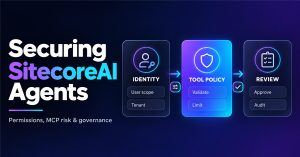 A practical guide to securing SitecoreAI agents across identity, content permissions, MCP tools, approval boundaries, and operational governance. Includes proposed policy records and a pilot acceptance-test plan, with documented product behavior separated from custom integration controls.
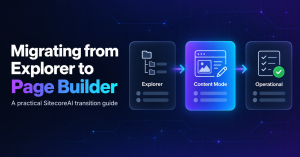 A practical, evidence-based guide to replacing Explorer workflows with Page Builder Content mode while preserving authoring, governance, and publishing controls.
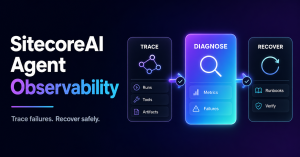 An operational design for correlating SitecoreAI agent executions, measuring useful outcomes, protecting sensitive data, and recovering safely from tool and workflow failures.
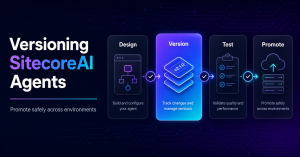 A practical guide to treating SitecoreAI agents as versioned production assets, with promotion gates, environment mapping, testing, rollback, and governance.
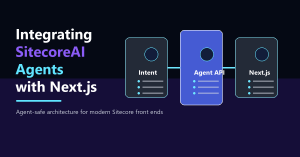 A practical architecture guide for connecting SitecoreAI agent workflows to a Next.js application without exposing credentials, bypassing approval, or confusing rendering with mutation.
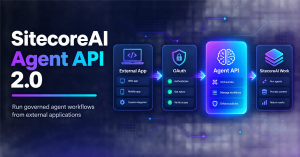 A practical architecture guide for running SitecoreAI Agent API 2.0 work from external applications with OAuth, request contracts, governance, observability, and v2 endpoint migration planning.
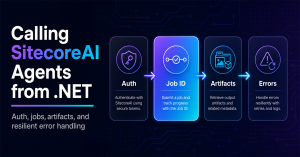 A production-oriented guide to authenticating .NET services, correlating SitecoreAI Agent API jobs, handling artifacts, classifying failures, and verifying rollback.
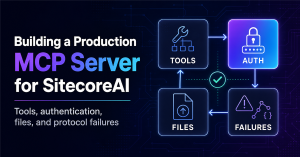 A production-focused guide to MCP servers for SitecoreAI, covering tool contracts, OAuth and tenant context, remote files, Base64 integrity, JSON-RPC failures, testing, and operations.
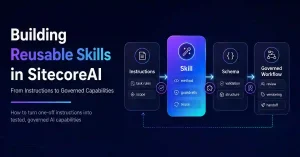 A practical continuation of the reusable schema article, showing how to implement a complete governed SitecoreAI skill with schema, artifact, workflow use, testing, and rollout.
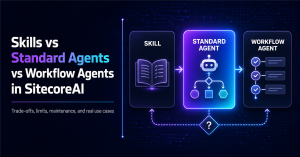 A practical decision guide for choosing SitecoreAI skills, standard agents, or workflow agents based on control, limits, maintenance cost, failure risk, and concrete use cases.
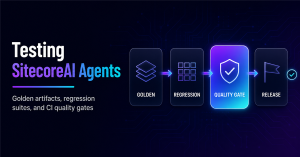 A practical engineering framework for testing SitecoreAI agents with versioned golden artifacts, risk-weighted regression suites, layered evaluators, and CI gates.
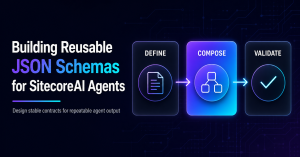 A practical guide to designing, composing, versioning, integrating, and testing reusable JSON Schema contracts for dependable SitecoreAI agent output.
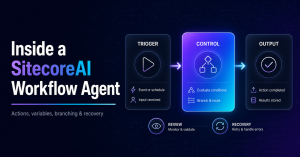 A practical technical guide to the execution model inside a SitecoreAI workflow agent, covering actions, variable contracts, branching, bounded retries, failure recovery, and operational testing.
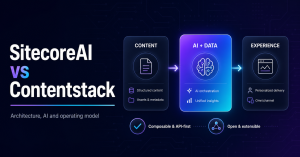 A practical comparison of SitecoreAI and Contentstack across architecture, authoring, AI, personalization, migration risk, and enterprise operating models.
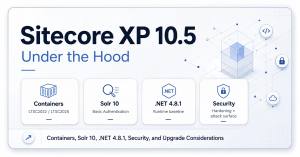 A practical engineering guide to Sitecore XP 10.5 covering the mandatory Solr 10 migration, Windows and SQL platform changes, .NET Framework 4.8.1, Sitecore Framework on .NET 10, security hardening, observability, messaging, breaking changes, and a staged 10.4-to-10.5 upgrade plan.
 Artifacts are the operational boundary between probabilistic agent output and governed SitecoreAI content. This implementation-focused guide explains artifact contracts, versioning, validation, provenance, review gates, multi-agent handoffs, and conversion into SitecoreAI items.
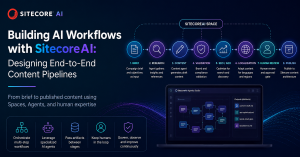 A practical SitecoreAI reference architecture for moving a campaign brief through specialized agents, approval gates, localization, and governed Sitecore delivery.
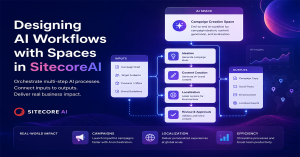 Introduction: AI workflows need more than prompts AI is now part of the daily marketing stack. Teams use it to research competitors, summarize audiences, draft campaign briefs, generate landing page copy, localize content, optimize page variants, and speed up repetitive work. But there’s a big difference between… Read more: Designing AI Workflows with Spaces in SitecoreAI
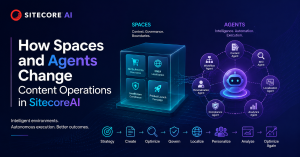 Modern content operations are under pressure from every direction. Teams are expected to produce more content, localize faster, personalize experiences in real time, and still maintain governance across channels. Traditional CMS workflows were never designed for this level of operational complexity. That’s where SitecoreAI introduces a major… Read more: How Spaces and Agents Change Content Operations in Sitecore AI
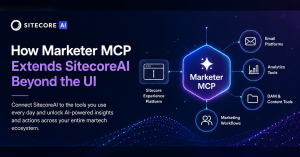 Introduction Artificial intelligence inside digital experience platforms is evolving quickly. Most AI-powered marketing tools focus heavily on user interfaces, dashboards, and workflows designed for marketers. While those interfaces are valuable, modern marketing operations increasingly require AI to work beyond the browser. That is where Marketer MCP changes… Read more: How Marketer MCP Extends SitecoreAI Beyond the UI
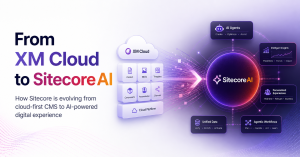 This is not just a new label on the same product story. It reflects a larger shift in how digital experience platforms are being used. Content teams no longer just need a CMS. They need a connected operating model for planning, creating, personalizing, testing, and improving experiences… Read more: From XM Cloud to SitecoreAI
 Si febrero sirvió para afinar Agentic Studio, marzo parece ser la actualización en la que Sitecore lo acerca mucho más al trabajo real de producción. El enfoque es bastante claro: trabajar directamente sobre contenido, hacer más prácticos los agentes personalizados y convertir los espacios en un entorno… Read more: Novedades de SitecoreAI Agentic Studio (marzo de 2026)
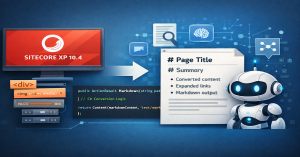 As more teams start building AI assistants, retrieval workflows, and search experiences on top of CMS content, one practical question keeps coming up: How do we expose Sitecore content in a format that’s easy for AI systems to consume? In many cases, the answer is Markdown. Markdown… Read more: Serving AI-Ready Markdown from Sitecore XP 10.4 MVC
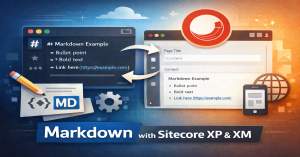 Markdown isn’t new, but it keeps earning its place. It’s fast to write, easy to read, and plays well with modern development workflows. If you’re working with Sitecore XP or XM, Markdown can be a practical alternative to rich text fields, especially for developer-friendly teams or content… Read more: Using Markdown with Sitecore XP and XM
 Broken internal links are one of those problems that quietly pile up in a Sitecore solution. Editors paste content, pages get renamed or moved, and suddenly your rich text fields are full of links that no longer go anywhere. Sitecore doesn’t validate internal links at render time… Read more: Building a Custom Sitecore RenderField Processor to Validate Internal Links in RTE Fields
 El viernes 21 de noviembre de 2025 fue una fecha especial para los estudiantes de Ingeniería en Sistemas de la Universidad San Francisco de Quito. Ese día, el SUGLATAM presentó un Workshop impartido por Ramiro Batallas y Gabriel Baldeón. El objetivo no fue solo compartir información, sino… Read more: Sitecore Workshop USFQ
 Marketplaces, Machines, and Momentum: The Real Story from Sitecore Symposium Introduction Sitecore Symposium has always been a temperature check on the state of digital experience. This year’s vibe was different. The center of gravity shifted decisively from “individual products” to “a platform you extend.” The signals were… Read more: Sitecore Symposium Insights
 Sitecore Stream keeps picking up momentum. What began as an AI assistant for content creation now reaches further into the nuts and bolts of content operations—how content gets ingested, structured, and enriched before anyone hits “publish.” Two recent releases—1.3.23 and 1.4.54—are key markers on that path: This… Read more: What’s New in Sitecore Stream: Smarter Imports, Smarter Images
 Introduction In the modern digital landscape, website performance is not just a nice-to-have—it’s a business-critical factor. Google’s Core Web Vitals (CWV) have shifted the way developers, marketers, and architects think about web optimization. These metrics—Largest Contentful Paint (LCP), First Input Delay (FID), and Cumulative Layout Shift (CLS)—play… Read more: Sitecore and Core Web Vitals. Changing the client cache