SitecoreAI vs Contentstack: Architecture, AI, and the Operating Model That Should Decide
Updated August 10, 2026.
“SitecoreAI versus Contentstack” sounds like a familiar CMS comparison. It is not. The two vendors now describe products that extend well beyond content storage and delivery. SitecoreAI is Sitecore’s cloud-native, SaaS, hybrid-headless digital experience platform, built on the foundation of XM Cloud and organized around content, assets, audience data, conversion optimization, and agentic workflows. Contentstack presents its Agentic Experience Platform, or AXP, as three connected systems: Content Cloud, Data Cloud, and Agent OS. Both want to be the operating system for digital experience teams. They start from different architectural instincts.
That distinction matters because a feature checklist can make the platforms look nearly interchangeable. Both support structured content. Both provide visual editing. Both expose APIs. Both talk about personalization, first-party data, brand governance, automation, and AI agents. Both can power modern JavaScript front ends. Yet the day-to-day consequences for developers, marketers, platform owners, and procurement teams can be very different.
This comparison focuses on those consequences. It uses current vendor documentation and product materials available on August 10, 2026. It does not pretend to replace a solution workshop, a security review, or a commercial proposal. Pricing, entitlements, regional availability, rate limits, and roadmap access can vary by contract. Treat every commercial assumption as something to validate in writing.
The short answer is this: SitecoreAI is the stronger default when an enterprise wants a broad, opinionated digital experience workspace with hybrid-headless page composition, integrated optimization, and Sitecore’s established enterprise operating model. Contentstack is the stronger default when an organization wants a structured-content core, explicit composability, and a platform model in which content, real-time customer intelligence, and autonomous agents remain understandable as separate but connected systems. Neither answer is universal. The right choice depends on which team boundaries you want the platform to absorb and which boundaries you want to preserve.
1. Reframe the Decision: You Are Choosing an Operating Model
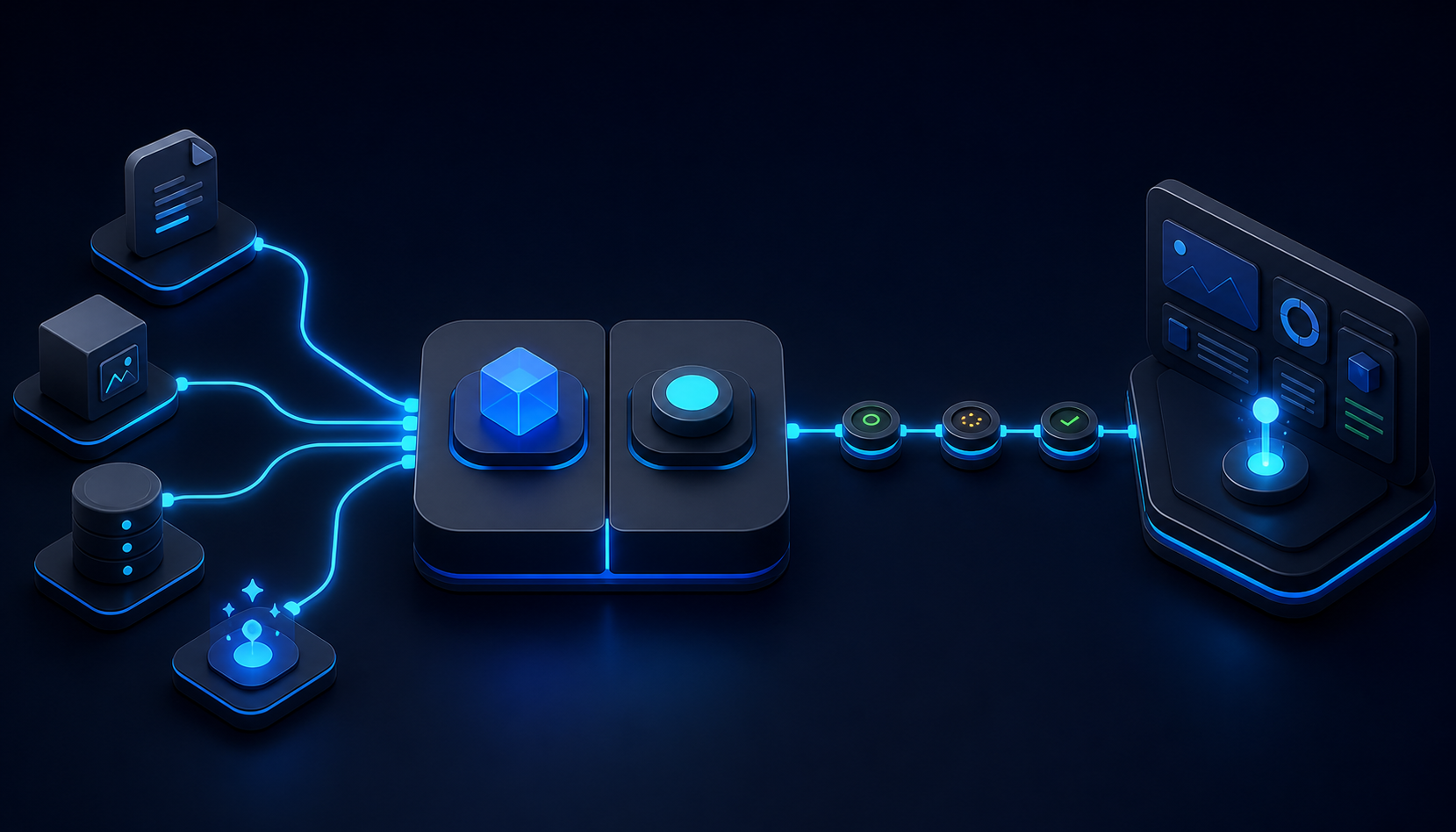
SitecoreAI is not simply a renamed content repository. Sitecore’s current documentation describes it as a unified, cloud-native platform that brings together content operations, digital asset management, content management, conversion optimization, audience and insights, and AI-assisted workflows. Its developer documentation is more specific: SitecoreAI is a SaaS, hybrid-headless DXP. “Hybrid headless” is the useful phrase. It signals that Sitecore wants developers to retain front-end freedom while marketers retain a WYSIWYG page-building experience.
The product lineage also matters. Sitecore announced SitecoreAI in November 2025 and stated that it was built on the foundation of XM Cloud. Sitecore’s transition FAQ says XM Cloud customers did not need to replatform and that XM Cloud would remain the core platform, with access to capabilities such as CDP and Personalize, Search, and Content Hub. That history explains why SitecoreAI feels like a unification move: existing Sitecore SaaS capabilities are being presented through one navigation and one AI-native story.
Contentstack’s current platform story begins from a different vocabulary. Its platform page describes an AXP composed of Content Cloud, Data Cloud, and Agent OS. Content Cloud includes the headless CMS, visual editing, Brand Kit, assets, and Launch hosting. Data Cloud includes Lytics, real-time profiles, Personalize, and omnichannel personalization. Agent OS includes the Polaris companion, Agent Builder, deterministic automations, and a directory of reusable agent blueprints. The model is integrated, but the seams are deliberate and visible.
That creates the first meaningful decision criterion: how much product-level opinion do you want around the experience lifecycle?
- Choose a more unified workspace when campaign planning, asset governance, page assembly, testing, personalization, and performance analysis should be coordinated inside one recognizable enterprise environment.
- Choose a more explicit composable system when teams want the content layer to remain conceptually clean, APIs to define boundaries, and adjacent data or agent capabilities to be adopted without hiding the underlying architecture.
This is not the old monolith-versus-headless argument. SitecoreAI is SaaS and hybrid headless. Contentstack has added visual experience tooling, personalization, hosting, customer data, and agents. The market has converged toward suites built from composable services. The remaining difference is where each vendor places the center of gravity.
SitecoreAI places it around the digital experience and the marketer’s continuous workflow. Its navigation groups work into Strategy, Channel, Design, Content, Performance, and Agentic areas. Agents, flows, signals, spaces, and user controls sit alongside page building and analytics. The desired motion is from plan to create to activate to optimize without losing context.
Contentstack places the center of gravity around structured content and activation. Content is the governed foundation. Data supplies audience intelligence. Agents act across that foundation. This separation can be valuable in organizations where content platform, customer data, and automation teams have distinct ownership. It can also demand sharper architecture governance because “composable” does not eliminate integration work; it makes integration choices explicit.
A useful way to test the distinction is to ask who owns the golden path. In SitecoreAI, the platform is more likely to define the standard route from site construction through personalization and optimization. In Contentstack, the enterprise architecture team is more likely to define how the CMS, front end, data layer, personalization decisioning, and agent runtime form the golden path—even when the vendor supplies all of those pieces.
My contestable view: enterprises routinely overvalue theoretical replaceability and undervalue a well-governed golden path. Composability creates value only when the organization has the ownership model to operate it.
This is why a request for proposal should not ask only, “Does the platform have personalization?” It should ask: Who defines audiences? Where are variants authored? Which service makes the decision? How is consent propagated? What does the front end call at runtime? Who monitors failed decisions? Which team can change the experience without a deployment? Those answers reveal the operating model hidden behind the feature name.
2. Architecture and Developer Experience
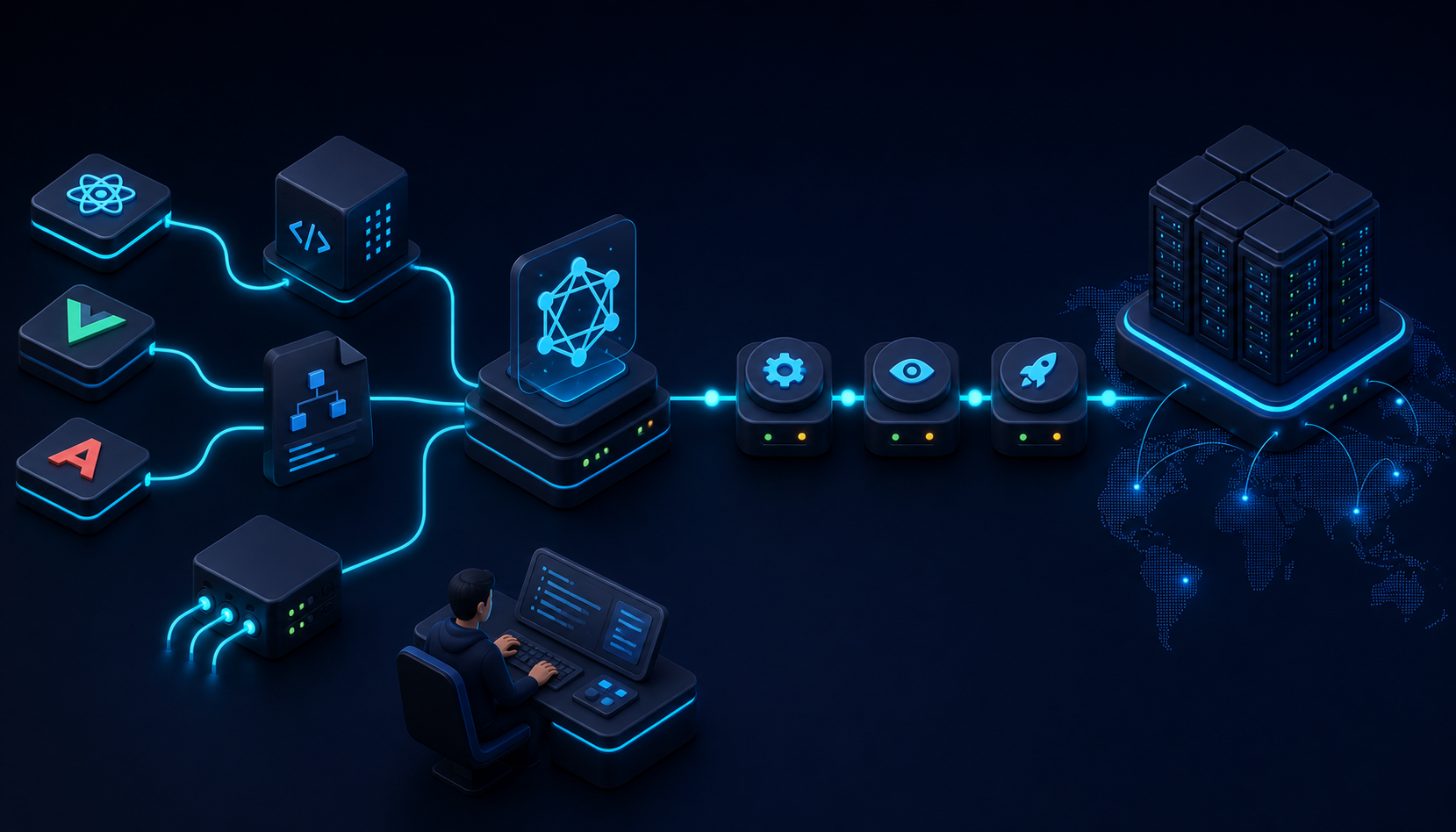
SitecoreAI’s developer documentation describes a set of interfaces that includes the Cloud Portal, Deploy app, Page builder, Explorer, Forms, and Analytics. Developers model content with data templates, create layouts and reusable components, connect components to data sources, and deliver content through Experience Edge GraphQL endpoints. The Content SDK connects modern front-end applications to SitecoreAI’s editing and delivery model. Sitecore also supports bringing your own React components and, in current documentation, framework-agnostic development within the set of technologies supported by the Content SDK.
That architecture is hybrid in a practical sense. Content and presentation are separated for delivery, but page composition remains a first-class concept. A content editor is not limited to filling fields in an abstract entry. The Page builder can visualize the page and permit routine composition changes. Developers therefore design two contracts: the content schema and the component contract that makes visual assembly safe.
Contentstack starts with a more canonical headless model. Its documentation describes a content backend separated from presentation. Applications retrieve published entries and assets through REST or GraphQL delivery APIs. The front end can use any technology that can call those APIs. Preview uses a separate Preview API and tokens, while the Live Preview SDK establishes communication between the editing interface and the website loaded in an iframe. Contentstack’s Visual Editor and Visual Builder add in-context editing without changing the underlying API-first model.
The architectural difference is subtle but operationally important. In SitecoreAI, page layout, component registration, visual authoring, and edge content delivery are designed as one product path. In Contentstack, structured entries are the durable core, while visual editing is an integration between the CMS, preview service, SDK, and your front end. Both can deliver a good editing experience. Their failure modes differ.
SitecoreAI implementation implications
- Component governance deserves early design. If every team invents its own data-source pattern and editing behavior, Page builder freedom becomes inconsistency.
- Experience Edge GraphQL shapes delivery. Query design, cache strategy, preview behavior, and publishing semantics should be tested with real page trees and localization depth.
- Sitecore concepts remain relevant even in SaaS. Templates, renderings, layout relationships, serialization, environments, and publishing require intentional ownership.
- The managed SaaS model removes infrastructure and upgrade work, but it does not remove solution architecture. Extensions, integrations, deployment pipelines, and observability remain yours.
Contentstack implementation implications
- Content types and global fields become the main long-lived contract. Poor models leak complexity into every channel.
- Preview is an application integration. Your front end must accept preview context, use the correct endpoint and token, and remain iframe-compatible where required.
- The separation between delivery and preview is clean, but teams must test authentication, caching, and accidental preview-data exposure.
- Front-end freedom is genuine. So is the responsibility to define rendering, routing, metadata, redirects, forms, search, and deployment conventions.
A small concrete artifact illustrates the shared direction. Both ecosystems expose GraphQL delivery patterns, but the exact endpoint, authentication, schema, and query constraints differ. A Contentstack delivery query conceptually looks like this:
query ArticleByUrl($url: String!) {
  all_article(where: { url: $url }, limit: 1) {
    items {
      title
      url
      body
      seo { title description }
    }
  }
}
The query is not the architecture. The architecture includes how a URL maps to an entry, how unpublished variants are previewed, how locale fallback works, how cache invalidation is triggered, how references are bounded, and what happens when the API is degraded. A proof of concept that fetches a title proves almost nothing.
For SitecoreAI, build a vertical slice that includes a page template, reusable components, an editor-created page, preview, publishing, Experience Edge delivery, a personalization variation, and deployment to a production-like host. For Contentstack, build the same slice using content types, references or modular blocks, Visual Editor integration, Preview API, Delivery API, webhooks, and the chosen hosting path. Measure the number of handoffs and failure points. Do not measure only developer time on the happy path.
My preference for multi-brand platform programs is to prototype the hardest governance boundary first. If regional teams may create components, test that. If components are centrally owned but content is local, test localization and fallback. If the platform must support web, app, kiosk, and AI retrieval, test whether the content model survives without page-specific assumptions. A demo homepage encourages the wrong optimization.
Neither platform absolves teams from designing a content API. SitecoreAI’s visual strength can tempt teams to model pages too literally. Contentstack’s schema freedom can tempt teams to build generic “everything blocks” that are hard to govern. The correct model captures semantic meaning, gives authors understandable controls, and allows channels to render appropriately. That principle matters more than the vendor logo.
Developer experience also includes local development and release management. SitecoreAI supplies deployment and serialization tooling tied to its project and environment model. Contentstack supplies APIs, SDKs, CLI capabilities, branches, releases, webhooks, Marketplace apps, and hosting options. Evaluate the full inner loop: create a field, migrate existing entries, update types, preview a component, run automated tests, deploy, publish, observe, and roll back. Ask each vendor to demonstrate the loop using your repository conventions and identity provider.
The practical verdict: SitecoreAI favors teams that want the presentation and content-development model to be productized together. Contentstack favors teams that want a strict content-service boundary and are comfortable productizing the rest of the delivery architecture themselves or through Contentstack’s adjacent services.
3. Marketer Experience and Content Operations
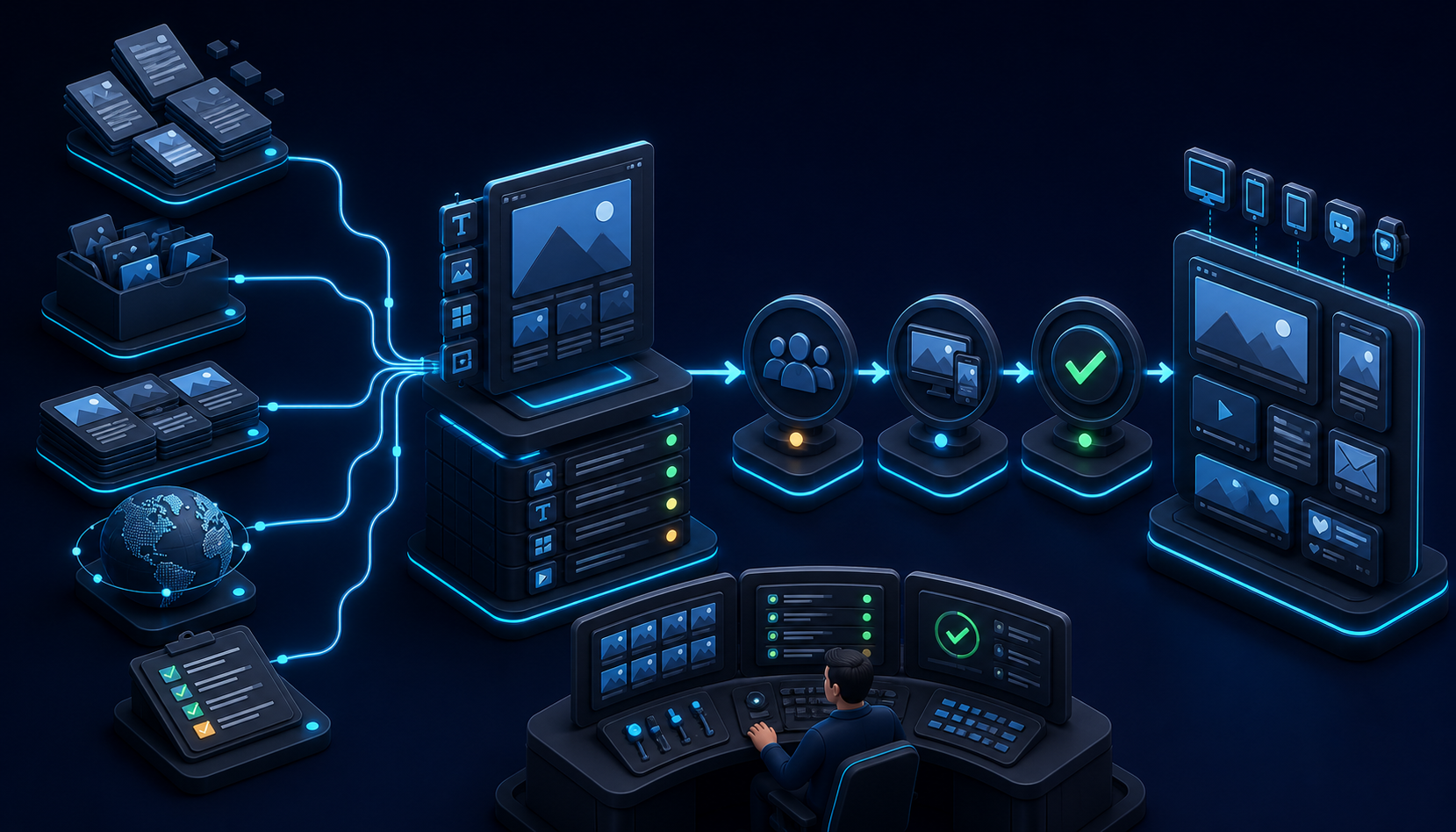
A CMS succeeds or fails in the minutes between an editor opening a task and confidently publishing a change. Vendor demonstrations often collapse that journey into a polished click sequence. Real organizations add localization, legal review, accessibility, asset rights, campaign dates, regional overrides, and emergency corrections. The correct comparison is not which editor looks nicer. It is which platform makes the organization’s content operating model easier to understand.
SitecoreAI’s unified workspace is designed around that end-to-end motion. Current Sitecore materials place campaign strategy, briefs, content operations, digital asset management, page and component design, performance, conversion optimization, and agentic work in connected areas. For a marketing organization already operating around campaigns and websites, the mental model is direct. A brief can lead to content and assets, those artifacts can become experiences, and performance can feed the next decision.
The hybrid-headless Page builder is a significant part of SitecoreAI’s marketer proposition. Authors can see changes in context, assemble approved components, and personalize the experience without treating every layout adjustment as a development ticket. The Components capability adds a visual grid-based builder with styles and versioning, while bring-your-own-component support gives developers a controlled extension path.
Contentstack approaches marketer enablement through structured authoring plus Visual Experience. Editors can manage entries, assets, variants, releases, workflows, and localization. Live Preview retrieves unpublished content through the Preview Service and displays changes on the front end. Visual editing lets authors work in context. Automate can expose configured validations, approvals, or custom processes from the editing interface. This keeps the structured content model visible while reducing the context switching associated with pure form-based headless editing.
The meaningful distinction appears when page composition and content reuse compete. SitecoreAI naturally treats the page experience as a primary working surface. Contentstack naturally treats the structured entry as the primary system record, even when it is edited visually. If most of your work is campaign-site production, SitecoreAI’s orientation may reduce friction. If content must be reused across many unrelated channels, Contentstack’s entry-centric discipline may be easier to preserve.
Questions that expose authoring reality
- Can an editor create a new landing page from approved building blocks without developer help?
- Can that editor accidentally create an inaccessible hierarchy, invalid component combination, or broken mobile layout?
- Can one semantic content object appear on web, mobile, email, support, and an AI answer without duplication?
- How are local market overrides represented, reviewed, and inherited?
- Can a release bundle content, assets, redirects, experiments, and configuration?
- What happens to scheduled content when one dependency fails validation?
- Can reviewers compare draft, current, and future states in context?
- How quickly can an authorized editor reverse a harmful publication?
SitecoreAI’s breadth can reduce tool switching, but only if the capabilities are licensed, configured, and governed as one system. A navigation item is not an operating model. Organizations should define shared taxonomy, asset metadata, campaign identifiers, approval responsibilities, and component ownership. Otherwise a unified workspace simply centralizes inconsistency.
Contentstack’s composable clarity can simplify content governance, but only if teams resist schema sprawl. Stacks, content types, global fields, modular structures, locales, environments, branches, and releases need conventions. A team that creates one content type per page template can reproduce a page-centric CMS badly. A team that creates a single universal page with unrestricted blocks can create a different form of chaos.
For both platforms, design an authoring contract. An authoring contract states what marketers may change, what the design system constrains, which fields are channel-neutral, how references behave, how previews are produced, and which actions require review. It should include examples of valid and invalid content. This artifact is as important as the content model diagram.
Localization is a revealing test. Ask teams to create a global article, translate it into two locales, override one legal paragraph in a region, retain a shared product reference, schedule a coordinated launch, and then retract only one locale. Observe which roles act, which screens they use, and whether fallback is obvious. The test exposes structural coupling, workflow limitations, and hidden manual coordination.
Asset governance is another. SitecoreAI brings digital asset management into the broader platform story. Contentstack’s platform now includes centralized assets inside Content Cloud and positions them as structured assets living with content. The procurement label “DAM included” is still insufficient. Verify renditions, transformations, focal points, rights metadata, expiration, duplicate detection, search, CDN behavior, and integration with any existing enterprise DAM. Moving binaries is easy compared with preserving rights and r…1269 tokens truncated… profile reduces stylistic drift. It does not prove factual accuracy. A knowledge vault improves grounding. It does not guarantee that the agent retrieved the correct item or interpreted it correctly. Human review reduces publication risk. It does not scale if every low-risk action requires the same approval. Governance must be risk-tiered.
A practical model has at least four action classes. Class one assists a user and changes nothing. Class two drafts content into a non-published state. Class three updates structured data or workflow state within defined limits. Class four activates an external experience, sends a message, or publishes. Each class should have different permissions, evaluation requirements, and rollback controls.
Run evaluations against real tasks before granting autonomy. Build a test set of campaign briefs, product facts, prohibited claims, localization cases, accessibility requirements, and adversarial instructions. Score factuality, brand adherence, schema validity, permission compliance, and successful tool completion. Repeat tests when models, prompts, knowledge, tools, or policies change.
Do not accept a vendor’s generic productivity statistic as your business case. Measure your process. Pick a bounded workflow such as adapting an approved product launch into three regional landing pages. Record baseline elapsed time, human touch time, revision count, defects, legal escalations, and content performance. Run the same work with the agent. A faster first draft with more corrections may be a loss.
SitecoreAI may appeal more to organizations that want agentic work embedded across a unified marketing lifecycle. Contentstack may appeal more to organizations that want agents treated as an explicit operating layer over structured content and real-time data. The distinction can narrow in implementation. The decisive factors are tool permissions, grounding, observability, evaluation, and commercial controls.
An admitted limitation of this comparison is that agent capabilities change faster than core CMS behavior. Vendor documentation can establish the current product model, but it cannot predict entitlement changes or roadmap delivery. Require a live demonstration using your permissions, content, brand rules, and failure cases. Put required controls in the contract rather than a slide deck.
5. Customer Data, Personalization, Testing, and Delivery

Personalization is a system, not an editor toggle. It begins with consented signals, identity, and audience logic. It continues through content variants and decisioning. It ends with delivery, impression tracking, conversion measurement, and feedback. A platform can provide each named capability while leaving critical connections to the implementation team.
SitecoreAI’s platform model connects audience and insights with conversion optimization, search, personalized experiences, A/B/n testing, and performance analysis. Page builder is documented as a surface for personalizing the user experience. Sitecore’s proposition is continuity: content, customer understanding, testing, and optimization are parts of the same environment rather than unrelated products.
Contentstack documents a concrete personalization architecture. Lytics collects behavioral data and builds profiles or audience membership. Personalize manages experiences, audiences, attributes, events, and rules. The Personalize Edge API determines active variants. Contentstack CMS stores entry variants, and the Content Delivery API retrieves the corresponding content. The vendor documents client-side and server-side implementation choices, making runtime responsibilities visible.
That visibility is useful. In a client-side rendering pattern, browser code sends events or attributes to the Personalize Edge API, receives active variants, and fetches personalized content from the Delivery API. Contentstack’s documentation explicitly notes the caching and latency implications of client-side personalization. Server-side decisioning can protect performance and reduce visual changes after load, but it moves identity, caching, and request orchestration into the server or edge layer.
SitecoreAI should be evaluated with the same request-level precision even if the product experience feels more unified. Ask for a sequence diagram showing signal collection, consent, profile resolution, audience evaluation, variant selection, content fetch, rendering, impression, conversion, and reporting. Identify which steps are synchronous. Record the regional endpoint and failure behavior for each.
Failure behavior determines customer experience
For every personalized component, define a safe default. If identity is unavailable, serve a non-personal baseline. If the decision service times out, avoid blocking the page. If the selected variant is unpublished, fall back predictably. If analytics collection fails, do not retry in a way that harms performance or duplicates conversions. If consent is withdrawn, stop collection and propagate the change according to policy.
Cache strategy cannot be added later. A fully personalized response can destroy shared-cache efficiency. Fragment personalization can preserve caching for most of a page. Edge decisioning can reduce latency, but only if identity and variant keys are designed carefully. Client-side personalization can simplify infrastructure but risks flicker, extra requests, and weaker first-render relevance. Choose per use case rather than declaring one universal pattern.
Experimentation also needs statistical and operational governance. Both platforms position testing and optimization as business capabilities, but teams must define hypotheses, primary metrics, guardrails, minimum sample requirements, exclusion rules, and stopping policies. The CMS should not become a casino of overlapping tests whose interactions nobody understands.
A useful evaluation scenario is an anonymous-to-known journey:
- A first-time visitor arrives with valid consent choices.
- Behavioral events update an anonymous profile.
- The visitor qualifies for an audience and receives a content variant.
- The visitor identifies through a conversion.
- The system merges identity according to policy.
- A later session continues the experience across a second channel.
- The visitor changes consent, and downstream systems honor it.
Test the full sequence. Watch network calls. Inspect identifiers. Verify what the editor sees, what the decision service returns, and what analytics records. A successful variant preview is not proof of a production personalization system.
Search belongs in the same experience discussion. SitecoreAI includes search experience capabilities in its conversion optimization area and frames discovery as part of the connected platform. Contentstack’s composable model has historically allowed teams to connect specialized search services, while the current AXP story expands native activation capabilities. Evaluate indexing triggers, schema mapping, synonyms, facets, personalization inputs, content security, preview indexing, and reindex recovery. Search freshness after an emergency content correction is a better test than relevance on a curated demo query.
Data portability deserves special attention. CDP and personalization decisions accumulate valuable state: profiles, audiences, events, experiment assignments, conversions, and derived scores. Ask how data can be exported, at what granularity, with what delay, and under which contract terms. SitecoreAI documents a data lake export service in its developer materials. Contentstack’s Data Cloud is built around Lytics and real-time behavioral data. In both cases, validate whether your warehouse remains a source, destination, or parallel system of record.
The choice often maps to organizational topology. If one digital experience team owns content, sites, personalization, testing, and optimization, SitecoreAI’s unified environment may align naturally. If a central data team owns profiles while channel teams consume audience intelligence through explicit services, Contentstack’s Content Cloud/Data Cloud separation may be easier to reason about. This is an inference from the documented product models, not a claim that either platform forbids the other topology.
Privacy architecture can overturn the feature winner. Map data categories, purposes, lawful basis, regions, retention, deletion, access, and subprocessors. Determine whether an agent can retrieve customer data, whether personalization uses sensitive attributes, and how subject requests propagate. Require evidence from security and privacy documentation. No personalization uplift compensates for a control failure.
6. Selection Framework, Migration Risk, and Practical Recommendation
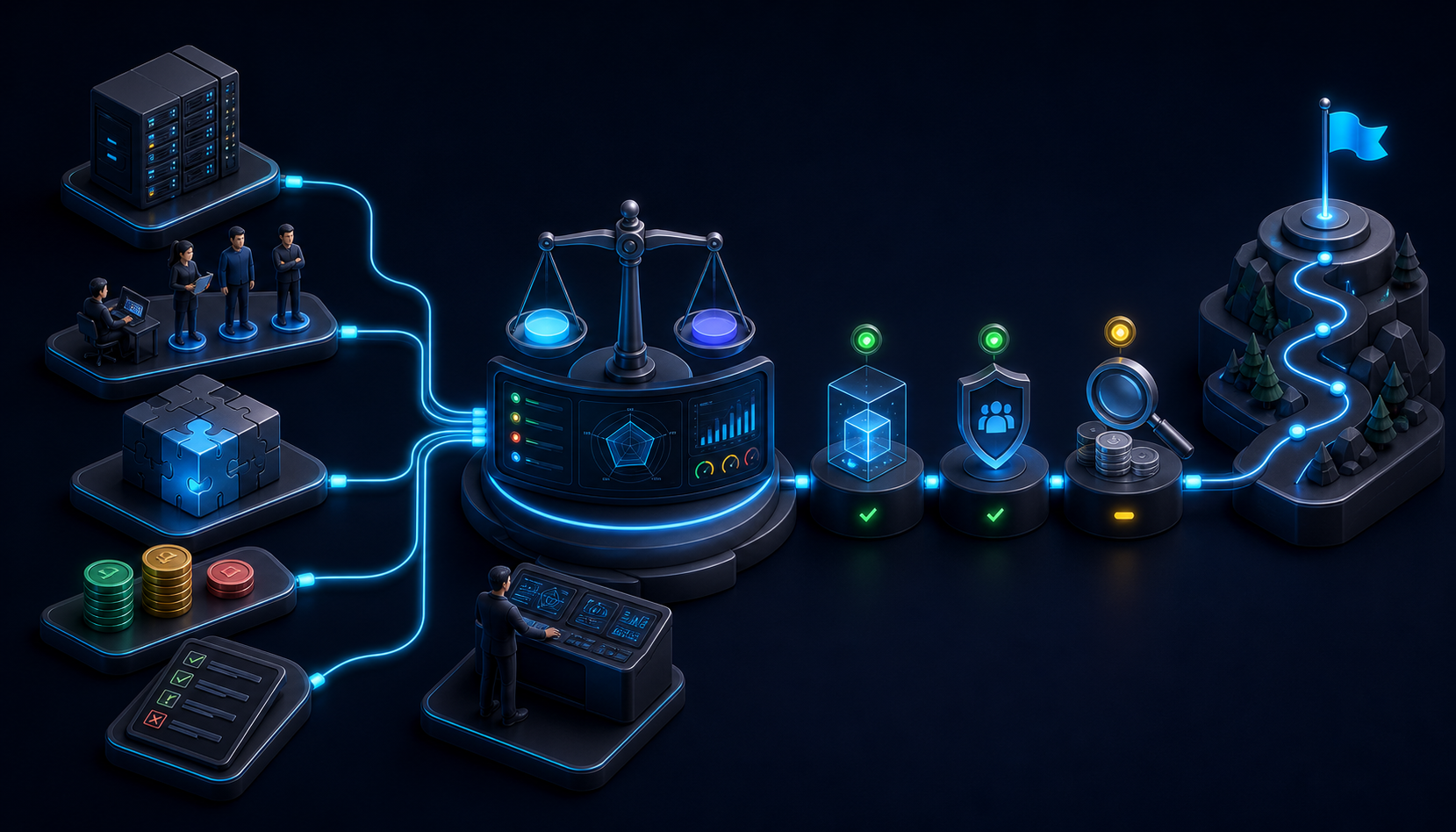
A platform selection should end with an operating decision, not a weighted spreadsheet that hides disagreement. Start by naming the outcomes, constraints, and ownership model. Then use product capabilities as evidence.
| Decision area | SitecoreAI tends to fit when… | Contentstack tends to fit when… |
|---|---|---|
| Experience model | Page composition, campaigns, optimization, and marketer continuity are central. | Structured, channel-neutral content and explicit API boundaries are central. |
| Architecture | You want a productized hybrid-headless path tied to Page builder and Experience Edge. | You want a canonical headless core with freedom to define the front-end and integration architecture. |
| AI | You want agents embedded across one marketing workspace. | You want an explicit Agent OS over governed content and real-time data. |
| Data and personalization | You prefer audience, optimization, testing, and experience tooling presented as one Sitecore environment. | You prefer visible separation between Content Cloud, Lytics-powered Data Cloud, Personalize, and runtime APIs. |
| Team topology | A centralized digital experience program owns the golden path. | Platform, data, and channel teams collaborate through governed contracts. |
| Existing estate | You already have XM Cloud or strategic Sitecore skills and want continuity. | You are standardizing on API-first content or replacing a page-centric legacy model. |
These are tendencies, not hard constraints. Contentstack can support visual page work. SitecoreAI can support channel-neutral structured content. The table identifies where each vendor’s documented product model creates a tailwind.
Score the platform and the operating burden separately
A traditional scorecard gives points for features and subtracts little for the work needed to make them reliable. Use two scores. The capability score asks whether the platform can perform the requirement. The operating score asks what your organization must build, govern, monitor, and support.
For example, both platforms can support visual editing. The operating questions include component instrumentation, preview security, iframe constraints, responsive behavior, editor training, accessibility guardrails, and incident support. Both can support personalization. The operating questions include consent, identity, runtime latency, cache fragmentation, fallback, experiment analysis, and privacy requests. The second score is where selection quality improves.
Run a proof of value, not a proof of technology
Give each platform the same production-shaped scenario. A useful scenario includes one global campaign, two locales, a reusable product object, three page components, one personalized variant, one A/B test, one AI-assisted adaptation, an approval flow, preview, scheduled release, analytics, and rollback. Integrate the real identity provider and deployment pipeline. Use representative roles rather than a vendor administrator account.
Measure elapsed time, human touch time, number of systems visited, deployment count, failed tasks, support interventions, and defects found after publication. Also collect qualitative notes from editors and developers. The goal is not to declare a benchmark that applies to every company. It is to observe your work.
Include failure injections. Expire a preview token. Remove a referenced asset. Delay the personalization service. Reject an AI draft. Publish a parent without a child. Change a schema while a release is pending. Revoke a user. Ask the agent to act outside its permission. A platform reveals its maturity when the happy path breaks.
Migration risk is primarily semantic
Teams often estimate migration by counting pages and assets. That misses the expensive work: deciding what the content means in the new system. A Sitecore estate may encode presentation in renderings, layouts, data sources, personalization rules, and custom fields. A legacy headless estate may contain duplicated types, deeply nested references, inconsistent locales, and front-end assumptions. Neither maps cleanly through a generic export.
Inventory these domains separately:
- Content types, fields, validations, references, and reuse patterns.
- Page structure, components, templates, routes, and metadata.
- Assets, renditions, rights, focal points, and embedded links.
- Locales, fallback, regional ownership, and translation workflows.
- Users, roles, workflows, releases, schedules, and audit history.
- Personalization rules, audiences, tests, goals, and analytics identifiers.
- Redirects, search indexes, forms, submissions, and integrations.
Then classify each item: migrate, transform, consolidate, archive, or retire. Build repeatable extraction and validation tools. Preserve source identifiers for reconciliation. Migrate assets before content that references them. Run link and reference checks. Compare counts by type and locale. Render critical pages and perform visual regression. Rehearse cutover with a measured freeze window and rollback plan.
If the organization is already on XM Cloud, Sitecore says the transition to SitecoreAI does not require replatforming. That is a material advantage, but “no replatform” does not mean “no change.” Navigation, entitlements, AI governance, team processes, and the gradual unification of shared services still require adoption planning. Existing customizations should be checked against current SaaS extension points.
If the organization is moving from an older coupled DXP to Contentstack, the architectural change may be larger. The migration includes a new front-end responsibility model and often a new content model. That can produce a cleaner long-term system, but only if budget includes product design, design-system work, routing, preview, forms, search, SEO, observability, and platform operations. License comparison alone will understate the program.
Commercial and governance due diligence
Request a bill of materials for the exact target state. Include production and non-production environments, users, locales, delivery traffic, preview traffic, assets and transformations, personalization, customer profiles, events, search, AI tokens or credits, agents, automations, hosting, support, sandbox access, and data export. Ask how overages work and which metrics can be monitored through APIs.
Map every required capability to one of four statuses: included, separately licensed, partner-provided, or custom-built. Attach the source and contract clause. Product pages describe possibility; contracts define entitlement.
Governance should name owners for content models, components, design tokens, APIs, integrations, identity, consent, audiences, experiments, AI policies, and cost. If ownership is “the platform team” for everything, the model is unfinished. A platform team can provide a paved road, but domain teams must own business semantics and outcomes.
Final recommendation
Shortlist SitecoreAI when the business case depends on a connected enterprise experience workspace: marketers planning campaigns, composing pages, managing assets, personalizing experiences, running tests, and working with agents inside a shared Sitecore model. It is especially compelling for XM Cloud customers because Sitecore positions the move as an upgrade rather than a replatform. Demand proof that the unified experience works across the capabilities and entitlements you will actually buy.
Shortlist Contentstack when the business case depends on a clean structured-content foundation, strong API boundaries, and an explicit architecture connecting content, real-time data, personalization, and agents. It is compelling for organizations with mature platform engineering and data ownership that want composability without abandoning integrated vendor capabilities. Demand proof that the seams remain operable under real workflows and failures.
If both remain viable, choose the platform whose operating model matches your organization after the consultants leave. SitecoreAI should win because the unified hybrid-headless path reduces handoffs and accelerates the experiences you actually deliver—not because a feature list is longer. Contentstack should win because its content-first, agentic architecture gives teams clearer contracts and faster change—not because “composable” sounds modern.
The durable decision is the one your teams can explain in a diagram, operate during an incident, govern across brands, and evolve without renegotiating every boundary. Run the vertical slice. Inject failure. Price the whole system. Then choose the model you are prepared to own.
Official sources used
- SitecoreAI user documentation
- SitecoreAI developer documentation
- SitecoreAI launch and transition FAQ
- SitecoreAI navigation and Agentic capabilities
- SitecoreAI launch announcement
- Contentstack AXP platform overview
- Contentstack layered architecture
- Contentstack Live Preview architecture
- Contentstack end-to-end personalization delivery
- Contentstack AI Assistant with Brand Kit