Testing SitecoreAI Agents: Golden Artifacts, Regression Suites, and CI Quality Gates
AI agents fail differently from conventional software. A function usually gives the same output for the same inputs. An agent can choose a different path, call a different tool, phrase a valid answer differently, or produce an artifact that looks polished while quietly violating a business rule. That makes ordinary unit testing necessary but insufficient. Teams need a test model that treats the agent configuration, context, tools, decisions, and final artifact as one observable system.
This guide presents that model for SitecoreAI Agentic studio. It is grounded in capabilities Sitecore documents today: custom standard and workflow agents, structured schemas, HTML templates, skills, tools, exported agent JSON, workflow runs, versioned artifacts, and human approval actions. The testing framework itself is an engineering pattern, not a claim that SitecoreAI ships a native CI runner. The goal is to show how to turn those platform primitives into repeatable evidence before an agent change reaches marketers or production workflows.
The core idea is simple. Preserve representative agent runs as golden artifacts. Replay them as a risk-weighted regression suite. Score each run with deterministic and semantic comparators. Convert the result into a CI status that can block a merge. Keep human judgment for changes where intent, brand, or legal meaning cannot be reduced to a stable rule.
1. Define the Real Testing Surface

A SitecoreAI agent is more than a prompt. Sitecore describes standard agents as systems configured with instructions, selected tools, context, skills, and a primary output format. Workflow agents add ordered actions, input and output variables, system prompts, message templates, linked schemas, templates, and artifact-storage choices. A meaningful test must therefore freeze or identify every input that can change behavior. Testing only the visible prompt leaves most of the executable specification outside the test.
Start with an inventory. Record the exported agent JSON, the user input, context parameters, attached items, selected brand kit, skill revisions, schema revision, template revision, enabled tools, locale, and any environment identifiers that influence retrieval. For a workflow agent, also record the action graph and the mappings between steps. Sitecore explicitly supports exporting an agent configuration as JSON, which makes that configuration a practical source-controlled test fixture. See the official guidance on exporting and importing agents.
Then identify external boundaries. An agent may search assets, create content, read a brief, add page components, invoke the Marketer MCP, or call an Agent API tool. Sitecore documents that the Marketer MCP exposes actions backed by Agent API endpoints and that operations follow Sitecore security, permissions, and approval workflows. Those calls are observable behavior. A test should capture the tool name, normalized arguments, result category, retry count, and order constraints when order matters. It should never log secrets, access tokens, or personal data merely to make a snapshot complete.
Separate contract from policy. A contract says the output must be valid JSON, contain required fields, or call a permitted tool with a valid site identifier. A policy says claims need citations, a page must follow brand tone, destructive actions need approval, or a localization must preserve legal language. Contracts are usually deterministic. Policies often need rubrics, reference data, or human review. Mixing them into one opaque score makes failures hard to diagnose and easy to waive.
Model side effects explicitly. A content-writing agent can generate an acceptable artifact and still update the wrong item. A page-building agent can create the correct component with the wrong datasource. A translation agent can return excellent copy while skipping one requested locale. Test the intended state transition, not only the prose. In a safe test environment, compare the pre-run and post-run state. In CI, prefer mocks, record/replay fixtures, or disposable tenants so the suite cannot mutate shared production content.
Define invariants before examples. Useful invariants include no tool outside an allowlist, no publish action without approval, no unknown schema properties, no missing locale, no citation to an unapproved domain, and no mutation when the run is classified as advisory. Invariants protect every case, including cases nobody anticipated. Golden artifacts then show how those invariants combine in representative journeys.
The final part of the surface is observability. Store the run identifier, timestamps, model or runtime identifier when exposed, tool trace, artifact, comparator results, and environment fingerprint. If a regression cannot be reproduced, the evidence should at least reveal which dependency moved. “The answer got worse” is not a useful defect report. “Case product-launch-en-014 lost required field claims[2].source after agent JSON revision 7f3c and schema v12” is actionable.
2. Build Golden Artifacts as Executable Specifications

A golden artifact is an approved record of a valuable agent behavior. It is not necessarily an exact string that every future run must reproduce. For generative systems, a useful golden packages inputs, configuration identity, expected structural properties, allowed behavior, forbidden behavior, semantic expectations, and one or more reviewed reference outputs. The reference output is evidence and an evaluation aid. It should not become a brittle demand for identical punctuation.
Sitecore calls an artifact the primary output generated by an agent or flow. Artifacts can be edited, refined, compared, and, in some cases, viewed as content, JSON, or preview. Saved versions are available in a space. Those capabilities make reviewed artifacts natural candidates for test baselines. The official artifact documentation also reinforces an important principle: the output has a lifecycle and versions, not just a transient chat response.
Use a manifest beside each golden. A practical manifest contains a stable case ID, purpose, owner, risk tier, input fixture references, agent configuration digest, dependency revisions, expected schema, tool policy, deterministic assertions, semantic rubric, reviewer, approval date, and expiration date. Include a short statement of why the case belongs in the suite. Without that statement, teams accumulate snapshots nobody understands and are afraid to update.
{
  "caseId": "campaign-brief-en-001",
  "risk": "high",
  "agentConfigSha256": "7b1f...91d2",
  "schema": "campaign-brief-v4",
  "inputs": ["fixtures/spring-launch.json"],
  "toolPolicy": {
    "allowed": ["briefs.read", "assets.search"],
    "forbidden": ["content.publish"]
  },
  "assertions": [
    "objective is present",
    "audiences has at least one item",
    "all factual claims include evidence"
  ],
  "review": {
    "owner": "content-ops",
    "approvedOn": "2026-08-13",
    "expiresOn": "2026-11-13"
  }
}
Choose goldens through review, not convenience. A successful run is not automatically correct. Have a domain owner verify facts, tone, completeness, safety, and intended side effects. Record edits made after generation. If the reviewer had to repair a claim or reinsert a required field, the untouched output should not be promoted as the golden. The approved artifact and the observed defects should both be retained so the comparator can learn what matters.
Version goldens immutably. A change to a golden is a specification change and deserves a pull request, rationale, and reviewer. Never overwrite the baseline merely because a new run failed. That practice converts regressions into approvals by accident. Create a new version, show the old and new comparator results, and explain whether the agent improved, the requirement changed, or the prior golden was wrong.
Prefer several acceptable references when output space is broad. A headline agent may have many valid responses. Two or three approved examples help a semantic grader recognize the intended quality range without treating one sentence as canonical. For structured artifacts, keep exact field-level examples but allow controlled variation inside fields. Normalize whitespace, ordering where order has no meaning, generated IDs, and timestamps before comparison.
Goldens also need negative evidence. Store forbidden claims, disallowed tools, examples of unacceptable tone, and edge cases the agent must refuse or escalate. A suite containing only happy-path outputs measures fluency, not reliability. One of the highest-value goldens for an action-capable agent is a request that sounds plausible but lacks authorization. The expected result is a safe stop or approval request, not successful execution.
Set an expiration policy. Brand rules, product facts, schemas, tools, and agent configuration change. A three-month-old creative reference may remain useful; a three-month-old pricing claim may be dangerous. Tag every dependency by volatility and require earlier review for volatile facts. An expired golden should not silently pass. It should produce a maintenance signal distinct from product failure.
3. Design a Corpus That Represents Risk

A regression corpus should mirror business risk, not the distribution of easy prompts. Begin with real tasks: generating a campaign brief, localizing a product page, creating a landing page, enriching account data, or assembling structured social content. For each task, identify the costly failure. It may be a false claim, a brand violation, a wrong-site mutation, a missing approval, or a malformed downstream payload. Allocate cases according to impact and likelihood.
Use a coverage matrix. Rows represent task families. Columns represent input quality, locale, content type, tool permissions, context availability, workflow branch, and risk condition. Mark which combinations have a golden, a deterministic contract test, a semantic test, or a human-only review. The matrix exposes gaps that a raw count hides. Two hundred variations of clean English copy do not compensate for zero tests of missing brand context or denied tool access.
Include canonical, boundary, adversarial, and recovery cases. Canonical cases prove the main journey. Boundary cases exercise maximum field lengths, empty optional arrays, uncommon locales, and ambiguous briefs. Adversarial cases attempt prompt injection, ask for unapproved actions, or include hostile instructions inside attached content. Recovery cases simulate a tool timeout, partial result, invalid schema, or approval rejection. The expected behavior may be retry, clarification, fallback, or safe termination.
Represent context explicitly. Sitecore notes that agents do not automatically know an organization’s tone, guidelines, or business context; configuration and contextual inputs determine behavior. Test with correct context, stale context, conflicting context, and no context. If an agent is expected to ask for clarification when a brand kit is absent, that behavior belongs in the golden. Do not quietly inject test-only knowledge that production runs will not have.
Test tool least privilege. SitecoreAI settings let administrators control which tools are available, and the documented tool catalog includes assets, briefs, components, content, jobs, pages, personalization, and sites. Build cases for the smallest expected allowlist. Verify that disabling a tool produces a controlled limitation rather than a fabricated success. Verify that a read-only task never requests a mutating capability. Treat a surprising tool selection as a first-class regression even when the final prose looks good.
Localization needs more than translated strings. Include locale-specific legal phrases, dates, units, product names, fallback behavior, and content fields that must remain untranslated. Compare structure across locales while scoring language separately. A useful invariant is that every requested locale produces one artifact with the same required schema. A useful semantic rule is that protected terminology remains unchanged. A human reviewer should own high-risk markets until the automated evidence is mature.
Use production failures as a sampling engine. When a marketer rejects an artifact, classify the reason and decide whether the incident represents a reusable requirement. If it does, minimize the input, remove sensitive content, add it to the corpus, and prove the current agent fails before accepting a fix. This turns feedback into a durable regression test. It also prevents teams from relying on anecdotes such as “the agent sometimes ignores tone.”
Keep a small pull-request suite and a deeper scheduled suite. The PR suite should contain fast, deterministic contracts and a representative sample of high-risk semantic cases. The scheduled suite can cover more locales, repeated runs, live integrations, and drift checks. A slow test that developers bypass provides no protection. A fast suite that ignores expensive failures provides false confidence. The two-tier design keeps feedback useful without shrinking coverage to whatever runs in five minutes.
4. Compare Outputs in Layers

No single similarity score can tell whether an agent output is acceptable. Use a stack of comparators ordered from cheapest and most objective to most contextual. Fail fast on malformed output or forbidden actions. Spend semantic evaluation only on runs that satisfy basic contracts. Route ambiguous, high-impact changes to people. This layered design produces explanations instead of a mysterious number.
Layer one validates execution. Did the run complete within its budget? Did every tool call return an allowed status? Were retries bounded? Did the workflow reach the expected terminal state? Were side effects confined to the disposable environment? A run that timed out should not be semantically graded as bad writing. It is an execution failure with different ownership and remediation.
Layer two validates structure. Sitecore supports reusable JSON schemas with required fields, data types, descriptions, validation rules, and control over additional properties. Use the same schema as the production contract whenever possible. Validate JSON before rendering an HTML template. Assert required arrays are nonempty, enum values are legal, URLs are parseable, and identifiers match fixtures. Structural failures are ideal CI gates because they are deterministic and easy to reproduce.
Layer three applies domain rules. Count requested outputs, enforce character limits, check terminology, verify that claims have sources, and confirm that protected content was not altered. Use exact rules for facts that must never vary. For example, a campaign artifact may require one objective, at least one audience, and a measurable success indicator. A localization may prohibit translation of registered product names. These rules should emit field paths and expected values.
Layer four evaluates tool behavior. Normalize arguments by removing generated IDs and sorting unordered collections. Compare the normalized trace with allowed patterns. Some cases require a tool; some permit either retrieval or clarification; some forbid every mutation. Express these expectations as a small policy language rather than snapshotting an entire trace. Exact trace matching is brittle because a capable agent may reach the same safe result through an equivalent sequence.
Layer five measures semantic quality against a rubric. Score factual support, task completion, audience fit, brand adherence, internal consistency, and harmful omission. Define each score level with observable anchors. “Good tone” is not an anchor. “Uses approved second-person voice, avoids the prohibited phrase list, and contains no unsupported superlatives” is closer. Require the evaluator to cite evidence from the artifact for every deduction.
An automated language-model grader can assist, but it is another probabilistic component. Freeze its rubric and runtime identity where possible. Test the grader on known pass, fail, and borderline examples. Use repeated grading or a deterministic rule for high-impact dimensions. Never let a grader override a hard safety invariant. If a grader cannot explain its decision with a field, quote, or trace event, treat the result as advisory.
Layer six is human judgment. Sitecore workflow agents include an Approval action that pauses execution until a person reviews and approves. Use that pattern where error cost exceeds automation confidence. Human review is not a failure of engineering. It is a deliberate comparator for brand nuance, legal meaning, novel claims, and irreversible actions. Record the decision and reason so recurring judgments can later become rules or rubric examples.
Aggregate results by severity, not arithmetic alone. A perfect style score cannot offset an unauthorized publish call. Define blocker dimensions, minimum per-dimension scores, and an overall target. Report both current score and delta from baseline. A small decline repeated across many cases can matter more than one large decline in a low-risk creative case.
5. Assemble the Regression Suite
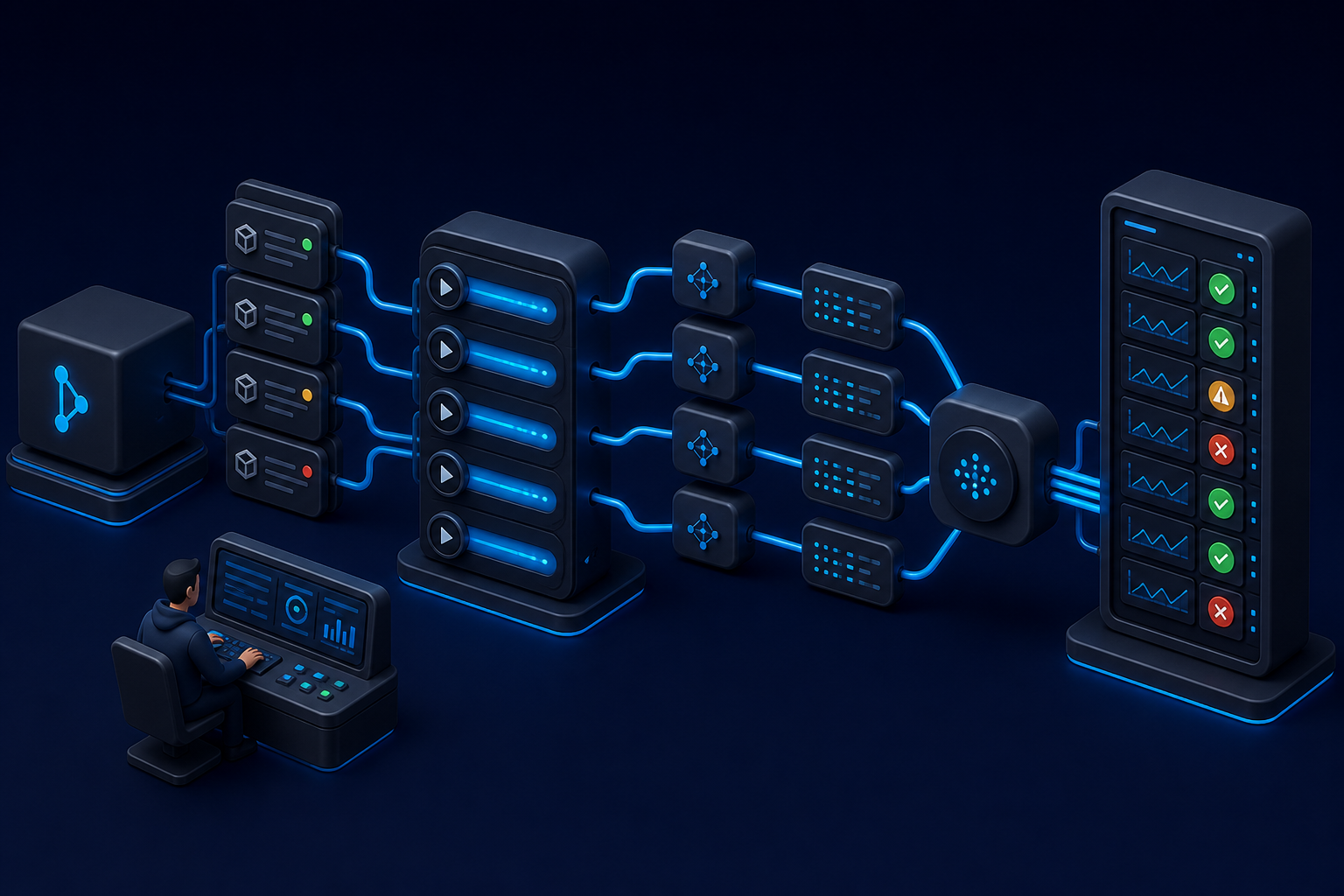
A maintainable suite separates case data, runners, adapters, comparators, and reports. Case data should be declarative. The runner should know how to import or target the intended agent revision, seed fixtures, execute a run, and collect evidence. Adapters should isolate SitecoreAI and external tool details. Comparators should accept normalized evidence. Reports should be stable enough for CI annotations and detailed enough for investigation.
A practical repository might contain agent exports under agents/, schemas under contracts/, sanitized input fixtures under cases/, approved references under goldens/, comparator code under evaluators/, and CI workflows under .github/workflows/. Keep credentials outside the repository. Store large binary references in an artifact store if needed, but commit their digests and metadata. Every test result should identify the exact commit and agent configuration digest.
Build an environment fingerprint before running cases. Include the suite version, agent digest, schema digests, skill identifiers, tool allowlist, locale set, and fixture revision. Add the runtime or model identifier only when the platform exposes it reliably. The fingerprint makes two reports comparable and prevents a test from claiming equivalence when its dependencies differ.
Mock at the correct boundary. Unit-level agent tests can return recorded tool responses and assert tool intent. Integration tests can use a sandbox SitecoreAI environment with seeded assets, briefs, sites, and content. End-to-end tests can exercise real approval and mutation paths in a disposable scope. Do not force every PR through the most expensive layer. A pyramid still helps: many contract tests, fewer integration tests, and a small number of full journeys.
Record/replay fixtures require governance. Scrub personal data and confidential content. Add an expiration date for responses that encode volatile facts. Detect schema drift between the recorded response and the current tool contract. A replay that accepts a response production can no longer return is worse than no test because it certifies an impossible path.
Make failures reproducible with a single case command. The command should print the case ID, fingerprint, seed if available, normalized trace, artifact location, comparator evidence, and rerun instructions. Avoid a framework that only produces a dashboard. Developers need local or on-demand reproduction. Content owners need the rendered artifact and a readable difference. Both views should link to the same evidence package.
cases:
  - id: product-page-en-007
    risk: high
    repeats: 3
    input: cases/product-page-en-007/input.json
    golden: goldens/product-page-en-007/v3/
    gates:
      schema: blocker
      forbiddenTool: blocker
      factualSupport: 0.95
      brandVoice: 0.85
      taskCompletion: 0.90
Parallelize only independent cases. Shared tenants and mutable fixtures can create cross-test contamination that looks like model instability. Give each mutating test a unique namespace or disposable site. Serialize cases that touch global settings. Clean up through explicit tracked actions rather than broad deletion. If cleanup fails, quarantine the environment, not the evidence.
Produce three report layers. The executive summary shows pass rate, blocker count, risk-weighted score, and recommendation. The case view shows expected versus observed behavior with evidence. The raw bundle contains trace and artifact data for debugging. A pull request comment should remain concise and link to details. Flooding reviewers with every successful semantic score trains them to ignore the report.
6. Control Nondeterminism Without Hiding Regressions
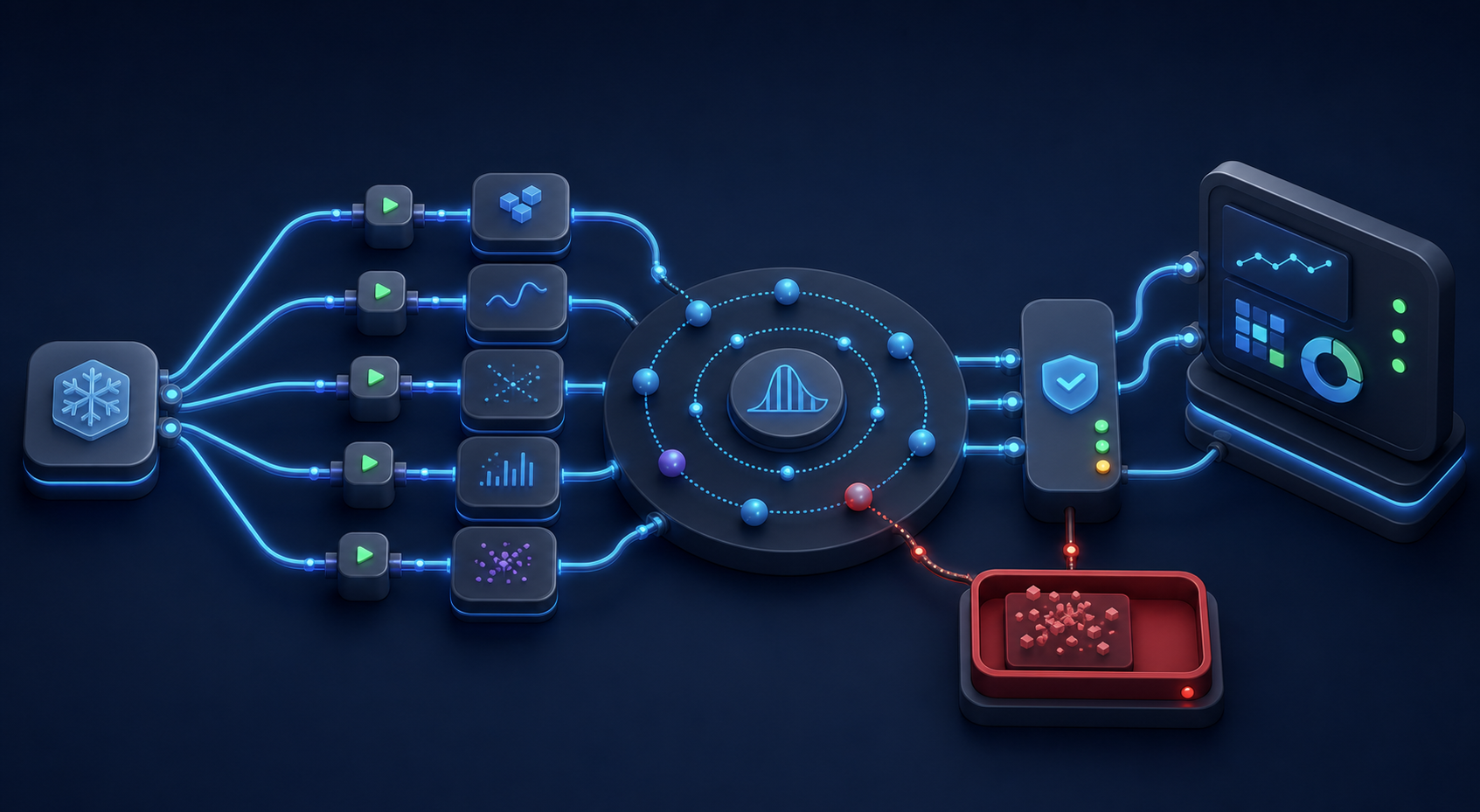
Generative variability is real, but “AI is nondeterministic” cannot become an exemption from testing. The task is to distinguish acceptable variation from meaningful behavioral change. Start by removing avoidable variation: freeze fixtures, normalize generated identifiers, pin configuration, isolate tools, and make time-dependent inputs explicit. Only then use statistical methods for the remaining variability.
Do not repeat every case by default. Repetition multiplies cost and can blur a deterministic defect. Repeat cases whose result depends on planning, tool selection, or semantic judgment, especially when the business risk is high. Run deterministic schema and policy checks once unless investigating infrastructure instability. Assign repeats by risk tier, such as one for low-risk contracts, three for important semantic cases, and five for release-critical action paths.
Define pass policies before seeing results. A high-risk case might require zero invariant violations across five runs, at least four successful task completions, and a median brand score above the threshold. A creative case might pass when all runs satisfy structure and at least two of three meet semantic quality. Predefined policies prevent teams from choosing the most favorable sample after a failure.
Report distributions. Median, minimum, failure count, and variance say more than an average. A mean of 0.88 can hide one dangerous hallucination among otherwise excellent outputs. For safety and authorization, use the worst run. For style, a median with a minimum floor may be reasonable. For latency, show percentiles and enforce a budget separately from quality.
Use paired comparisons when evaluating a change. Run the baseline and candidate on the same case fixtures and, when supported, comparable run conditions. Compare per-case deltas rather than two unrelated aggregate averages. A candidate that improves common cases but sharply degrades one high-risk locale should not pass because its global mean rose.
Quarantine is a temporary containment tool, not a graveyard. A flaky test needs an owner, reason, creation date, diagnostic link, and deadline. It should remain visible in reports and run on the schedule even when it no longer blocks PRs. Cap the allowed quarantined risk weight. If the cap is exceeded, block releases until the debt is reduced.
Detect dependency drift separately from code regression. If unchanged agent JSON and unchanged fixtures produce a sustained shift, inspect context sources, tool results, schemas, platform changes, and evaluator behavior. Keep a small canary suite that runs on a schedule against the approved revision. Its purpose is not to approve code; it alerts the team that the operating environment moved.
When a result is borderline, preserve uncertainty. Mark it review-required rather than forcing pass or fail. A traffic-light status with evidence is more honest than decimal precision unsupported by the rubric. Over time, analyze reviewer decisions. If reviewers consistently approve a class of borderline outputs, update the rubric or threshold through a reviewed change. If they reject them, add clearer negative examples.
7. Turn Evidence Into CI Quality Gates

A CI gate converts test evidence into a merge decision. The simplest design has three stages. Contract tests validate agent exports, schemas, templates, fixture references, and policy files. The regression runner executes the selected cases and publishes evidence. A gate job evaluates blocker rules and risk-weighted thresholds. The gate job alone reports the required status, which keeps branch protection configuration stable while the suite evolves.
GitHub documents that required status checks must be successful, skipped, or neutral before a protected branch can merge. It also supports restricting a required check to an expected GitHub App. That makes the quality-gate job a practical enforcement point. See GitHub’s protected branch documentation. The same pattern applies to other CI systems that expose protected merge conditions.
Use hard blockers sparingly and clearly. Block on invalid agent JSON, schema incompatibility, forbidden tool use, unauthorized mutation, missing required output, severe factual failure, or a high-risk case below its floor. Do not block every punctuation change or minor rubric fluctuation. Excessive gates create waiver pressure. A few defensible gates produce better behavior than dozens of noisy checks.
Add a changed-path selector. A schema change should run every case that consumes the schema. An agent instruction change should run its full PR suite. A shared skill or tool adapter change may require multiple agents. Encode dependency links in metadata rather than relying only on file paths. If the selector is uncertain, choose broader coverage and say why in the report.
Separate PR, nightly, and release gates. PR gates emphasize speed and direct impact. Nightly runs expand locales, repeats, integrations, and drift canaries. Release gates use the approved candidate revision, a clean environment, and the highest-risk end-to-end journeys. A release should not rely on a nightly result from a different commit or configuration digest.
name: agent-quality
on: pull_request
jobs:
  contracts:
    steps:
      - run: agent-tests validate
  regression:
    needs: contracts
    steps:
      - run: agent-tests run --suite pr --report evidence/
  quality-gate:
    needs: regression
    steps:
      - run: agent-tests gate evidence/summary.json --policy policies/pr.json
Make approvals explicit. Sitecore documents an Approval workflow action that pauses until a human approves. CI can mirror that principle for baseline updates and high-impact changes. Require a content owner for semantic goldens, a platform owner for tool permissions, and a security or legal owner where applicable. Code review alone does not establish that a new marketing claim is correct.
Prevent baseline laundering. The same pull request may update an agent and its goldens, but the report must show results against both old and proposed baselines. Require a reason code for every changed expectation. Large baseline rewrites should receive dedicated review. A policy that automatically accepts candidate output after repeated failures destroys the gate’s purpose.
Define waiver mechanics before an incident. A waiver needs scope, owner, rationale, compensating control, expiration, and a link to remediation. It should apply to named cases or rules, not disable the full suite. Expired waivers fail closed. Track waiver frequency as a quality metric; repeated waivers often indicate a bad comparator, an unrealistic threshold, or neglected agent design.
Keep credentials and side effects contained. CI should use a dedicated identity with least privilege, a disposable or isolated environment, and short-lived credentials. A read test should not receive publish permission. A mutation test should target uniquely named fixtures and record every created resource for safe cleanup. Never run destructive recovery logic against a broad tenant scope.
8. Operate Quality as a Continuous Loop

Passing CI is the start of operational evidence, not the end. Agents encounter new briefs, context, tools, languages, and user strategies after release. Establish a feedback path from marketer edits, rejected approvals, failed jobs, support incidents, and audit findings into the regression backlog. The team should be able to answer which production lessons became tests and how long that conversion took.
Instrument decisions without collecting unnecessary content. Track case-like categories, tool outcomes, approval results, edit distance at a coarse or field level, failure reasons, and latency. Protect customer data and honor retention requirements. Production artifacts should not be copied into a test corpus until they are reviewed, minimized, and sanitized. Metadata can reveal trends before raw content is authorized for analysis.
Review metrics by risk. Overall pass rate is useful but easy to game. Add blocker escape count, high-risk case pass rate, review-required rate, flaky risk weight, mean time to reproduce, mean time to add a regression, baseline age, waiver count, and percentage of runs using least-privilege tool sets. These metrics expose weaknesses that a single quality score conceals.
Assign ownership at three levels. Agent owners maintain instructions, workflows, and exports. Domain owners approve meaning, facts, brand, and goldens. Platform owners maintain runners, adapters, environments, and CI policy. Security owners define prohibited actions and evidence handling. Shared ownership does not mean vague ownership; every failing rule and expiring golden needs one accountable queue.
Schedule baseline review according to volatility. Stable formatting examples may need annual review. Campaign facts, product capabilities, legal wording, and tool contracts need shorter cycles. Use the artifact’s dependency metadata to trigger targeted review when a schema, skill, brand kit, or external contract changes. A scheduled date is a fallback, not the only invalidation mechanism.
Run a small red-team program. Try hostile instructions in uploaded files, requests to bypass approval, ambiguous site names, conflicting brand context, unsupported claims, and tool results that contain instructions. Verify that the agent follows trusted configuration and treats retrieved content as data. Promote every confirmed weakness into a minimized negative golden with a hard invariant when possible.
Admit the limitation of offline evaluation. A regression suite samples known behavior. It cannot prove that every future prompt is safe, factually correct, or on brand. Semantic graders can share blind spots with the agent. Human reviewers can disagree. Tool sandboxes may differ from production. That is why the operating model combines pre-merge gates, release journeys, human approval, telemetry, incident response, and recurring corpus improvement.
A practical rollout starts small. In the first two weeks, export one important agent, define its surface, and capture ten reviewed cases. Add schema and tool-policy blockers before semantic scoring. In the next month, introduce a documented rubric, a PR sample, and a nightly repeated suite. Then connect the gate to branch protection, add baseline approvals, and establish the production feedback loop. The order matters: trustworthy evidence should precede strict enforcement.
My preference is to gate invariants early and semantic aggregates later. Teams usually know which actions and structures are unacceptable before they can agree on a reliable “quality” number. Early deterministic gates catch serious defects with little debate. Semantic thresholds should become blocking only after the rubric has been calibrated against reviewer decisions and its false-positive rate is understood.
The durable deliverable is not a giant test harness. It is a chain of evidence: versioned agent configuration, representative inputs, reviewed goldens, explicit comparators, reproducible results, and accountable decisions. SitecoreAI already exposes many of the building blocks—structured outputs, configurable tools, workflow runs, artifact versions, exported JSON, and human approval. Engineering them into a regression discipline gives teams a safer way to evolve agents without freezing experimentation.
Begin with one question for every proposed agent change: what approved behavior could this break? Turn the answer into a case, a comparator, and a gate proportional to the risk. When the next failure occurs, preserve it as a new test. That loop is how agent quality compounds.
Failure triage should follow the comparator stack. First confirm that the evidence package matches the candidate commit and expected environment fingerprint. Next inspect execution and structure before debating prose. If the run called a forbidden tool, malformed the schema, or mutated the wrong fixture, semantic quality is irrelevant. Assign the defect to the agent configuration, workflow mapping, tool adapter, fixture, comparator, or environment. A named failure class speeds ownership and prevents every incident from becoming a prompt rewrite.
When the artifact is semantically weak, identify the smallest violated requirement. Do not respond with a broad instruction such as “make the agent better.” If the artifact contains an unsupported claim, add or refine a citation rule and preserve the exact evidence. If it misses the target audience, improve the input contract or context mapping. If the grader disagrees with reviewers, fix the rubric or grader examples before changing the agent. A test system is itself software and can be wrong.
Use a four-way disposition for failed cases: product regression, specification change, test defect, or dependency drift. Product regressions require an agent or workflow fix. Specification changes require a reviewed baseline proposal. Test defects require comparator or fixture repair and proof that known bad behavior still fails. Dependency drift requires investigation of context, tools, platform behavior, or evaluators. Recording the disposition creates data about where quality effort is actually going.
Baseline maintenance deserves a service-level expectation. High-risk expired goldens should block a release or require an explicit waiver. Low-risk expired cases can warn for a short grace period. Reviewers should see the old artifact, proposed artifact, field-level differences, trace differences, rubric deltas, and the author’s rationale together. Asking someone to approve a raw directory of snapshots is not governance; it is fatigue.
Cost controls also belong in the design. Estimate the number of agent runs, tool calls, repeated evaluations, and human reviews for each suite. Put a budget on pull requests and alert when a change expands it unexpectedly. Prefer deterministic checks before expensive semantic graders. Cache immutable fixture preparation, not final agent results. A cached answer can make the suite fast by skipping the behavior it claims to test.
Finally, test the test system. Seed known malformed artifacts and confirm contract checks fail. Seed an unauthorized tool trace and confirm the blocker triggers. Feed the semantic evaluator approved, rejected, and borderline examples and measure agreement with reviewers. Simulate a missing evidence bundle and verify the gate fails closed. Exercise waiver expiration. A quality gate that has never demonstrated a controlled failure is only a status badge.
Reference Checklist
- Export the SitecoreAI agent JSON and calculate a configuration digest.
- Freeze sanitized inputs, dependency revisions, and tool permissions.
- Store reviewed artifact versions with rationale, owner, and expiration.
- Validate execution, schema, domain rules, tool behavior, and semantic quality separately.
- Use human approval for ambiguous or irreversible outcomes.
- Run fast risk-weighted cases on pull requests and broader suites on a schedule.
- Make one stable gate job the required CI status.
- Show old-baseline and proposed-baseline results for expectation changes.
- Quarantine flaky tests with owners and deadlines.
- Convert production defects and reviewer rejections into sanitized regression cases.
For platform details, consult Sitecore’s documentation on understanding agents, reusable schemas, building and testing workflow agents, and workflow actions including approval.