Designing Provenance and Source Tracking for AI-Generated Content
A source list tells a reader where to look. A provenance record should also explain which source revision contributed to which content revision, what transformation occurred, and who took responsibility for the next decision. Those questions become harder after a draft is edited, translated, converted into a content item, and reused in another campaign. A citation copied through every stage can appear reassuring even after the claim it originally supported has changed.
This article proposes a provenance design for AI-generated content, using a hypothetical SitecoreAI product-guide workflow as the running example. The application records and procedures are design recommendations, not undocumented native APIs. The article does not claim a deployed customer implementation or measured outcome. Its objective is practical: let an editor investigate a claim, let an operator trace a transformation, and let a content owner identify work affected by a changed source.
My position is that provenance should preserve uncertainty rather than turn every generated statement into an apparently sourced fact. A smaller record with precise relationships is more useful than a large archive of links whose role nobody can explain. That preference requires deliberate decisions about identity, access, and retention. The following design keeps those decisions connected to actual review and correction work.
1. Decide which provenance questions the system must answer

Start with the decisions the record must support
Choose the questions before choosing a database or graph format. For the hypothetical guide, an editor needs to identify the evidence supporting a product claim. A campaign owner needs to know whether that evidence applies to the intended market. An operator needs to trace the content revision produced by a particular transformation. A source owner needs to find affected content when a specification changes. These questions require related but different views. A single unstructured note saying generated from approved sources may answer none of them.
Define the unit of provenance. A document-level relationship can explain that a source packet informed a draft. A field-level relationship can connect a summary to its inputs. A claim-level relationship can support a specific factual assertion. Choose granularity according to the decisions and consequences. Do not promise claim-level support if the process records only a link to a whole website. Conversely, do not build a costly sentence-level graph for exploratory content if nobody needs that detail to review or correct it.
Distinguish source origin from source suitability. A source may be identified accurately but outdated, irrelevant to the market, or insufficient for the wording of a claim. The provenance system should retain those distinctions rather than presenting every known origin as approved evidence. Define the status that a source owner or reviewer can assign and the conditions under which content may proceed. The system should record the decision’s subject and authority, not infer approval from the fact that a document was accessible to the agent.
Separate provenance, factuality, and authorization
The C2PA explainer distinguishes provenance evidence from a judgment that content is factually true. That distinction is useful beyond media credentials. In this proposed content workflow, a lineage record describes origin and transformation. A factual review checks whether evidence supports a statement. An authorization record permits a defined action. Keep them linked but separate. A well-preserved history should not automatically grant publication authority or convert an unsupported claim into a verified one.
For the product guide, define an important claim as one the editorial policy requires evidence for. Avoid making the model the sole authority on which statements deserve support. The organization can choose a practical rule for product capabilities, comparisons, or offer conditions. Record creative suggestions and hypothetical examples differently from factual product assertions. A hypothetical campaign number should not enter the evidence graph as an observed result simply because it appears in a polished paragraph with a citation nearby.
Set the expected completeness of each record. A draft may legitimately have unresolved claim support while it waits for review. A release packet may require all material claims to have accepted evidence or a permitted exception. Describe those states explicitly. Do not make a missing source reference look identical to a claim that needs no source under policy. The difference helps reviewers focus on unresolved work and helps operators distinguish a data-capture failure from an intentional content classification.
Design for known limits
Decide what the system can observe directly. A generation service may expose the selected context and produced artifact without exposing every internal model influence. Record the available evidence and do not claim complete causal explanation from it. A source included in a prompt is not necessarily proof that a particular sentence was derived exclusively from that source. The application can record asserted support and reviewer verification while remaining honest about the limits of observing generation.
Avoid treating an agent’s post-hoc bibliography as a complete execution trace. The model can propose relevant references, but a trusted process should verify that the references exist, are permitted for the task, and support the wording. Preserve whether a relationship came from configured input, a tool observation, a model suggestion, or a human decision. Those origins affect how the record should be interpreted. Do not flatten them all into one generic source field that hides which relationships were actually checked.
Define who owns each question. Editorial owners decide support requirements. Source owners determine whether a document is current and applicable. Integration owners capture transformation evidence. Operators diagnose missing or inconsistent records. One team member may fill several roles, but the responsibilities should remain visible. A provenance store without decision ownership can become an archive of unanswered questions. The useful design links each unresolved condition to someone who can inspect the evidence and choose the next action.
The acceptance exercise is simple: select one claim from a draft and ask an editor who did not see the generation conversation to explain its origin and support status. Then ask an operator to identify the transformation that placed it in the current revision. If they need private memory from the original author, the record is incomplete for that purpose. Improve the missing relationship before adding more metadata merely to make the archive look extensive.
2. Model sources, transformations, and responsibility
Use a small explicit relationship model
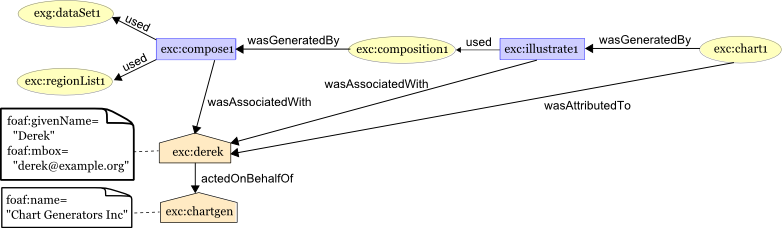
The W3C PROV Primer provides a vocabulary of entities, activities, and responsible agents. A source revision can be an entity; drafting or translation can be an activity; a person or software service can have a role in that activity. The PROV ontology formalizes relationships for systems that need that representation. The design below borrows those concepts. It does not claim that SitecoreAI exposes a native PROV graph or that every implementation needs RDF.
Figure source: PROV Model Primer, W3C Working Group Note, 30 April 2013. Copyright © 2013 W3C® (MIT, ERCIM, Keio, Beihang), All Rights Reserved. Unmodified diagram reused under the W3C document license.
For the hypothetical application, identify source documents separately from their revisions. A stable source reference groups the document over time, while a revision reference identifies the material used for one transformation. Do the same for generated artifacts where the supported interface permits it. A reference meaning current product specification is not enough to explain what a draft used several months earlier. Preserve the specific available version or a controlled snapshot reference, subject to the source system’s permissions and retention policy.
Give transformations their own identity. A generation, editorial revision, translation, and content-model conversion are different activities even when they happen during one campaign request. Record their inputs and outputs at the granularity the application needs. Keep the campaign request as a grouping reference rather than pretending every action under it is one indivisible event. This lets an operator distinguish a draft generated from one source packet from a later localized revision based on additional regional evidence.
Record roles without confusing software and human responsibility
Identify who or what performed the transformation and who reviewed its result. A software execution identity and an editorial reviewer answer different questions. The first may explain which service made a write. The second explains who accepted a claim or authorized a release. Preserve those roles separately. Do not label the model as the human author or imply that a reviewer approved every later transformation merely because they accepted an earlier draft in the same campaign.
Use authenticated actor references for trusted decisions. A model-generated reviewer name is data, not evidence that the named person made a decision. The approval or review service should establish the actual actor under its supported identity mechanism. Keep personal information limited to what the organization needs and is permitted to retain. A provenance graph can expose relationships between people and confidential projects, so access design matters even when the article body itself is intended for publication.
The following object illustrates a small application-owned transformation record. It is not a Sitecore API schema, and its references are placeholders.
{
  "activityRef": "guide-translation-12",
  "kind": "translation",
  "inputRevisionRefs": ["guide-source-revision-7"],
  "outputRevisionRef": "guide-localized-revision-2",
  "configurationRef": "translation-contract-3",
  "performedByRef": "authenticated-service-reference",
  "reviewState": "awaiting_regional_review"
}
Attach configuration references where they help explain the transformation. A mapping revision or translation policy can be relevant. Record the prompt or model configuration only to the extent available and appropriate under the organization’s policies. Do not invent hidden identifiers the service does not expose. If a resource is mutable, determine how the application can preserve the relevant representation or acknowledge the limitation. A name pointing to the latest configuration may not identify the settings used by an earlier activity.
Make relationships queryable and interpretable
Choose storage according to the queries the application must support. A relational design with explicit relationship tables may be sufficient. A graph representation may be useful for complex traversal. This article does not prescribe one technology. The requirement is that the implementation can retrieve the source-to-output and output-to-source relationships needed for review and correction. Test those queries with representative data before optimizing the visual presentation. A compelling lineage diagram is not evidence that the underlying relationships are complete.
Define relation meanings carefully. Used as input differs from supports claim. Derived from differs from approved for publication. A source list can record availability without proving factual support. Keep those predicates distinct in the application model or explain their exact local meanings. If a relation is asserted by the model and later confirmed by a reviewer, preserve that progression rather than overwriting the original origin. The distinction helps investigate whether a problem came from generation, evidence selection, or review.
Test the model with a branched example. One source revision informs two guides; one guide is translated; one translated claim receives new regional evidence. Ask the application to trace each output backward and identify the outputs affected by a changed source. Verify the returned set against the fixture. A record model that handles only a simple chain may fail to represent reuse honestly. Expand the relationship design only as needed to answer the supported questions, and keep unobserved relationships explicitly unknown.
3. Bind claims to evidence and record uncertainty

Bind evidence to the actual wording
For each material claim in the proposed guide, preserve a stable claim reference or field-and-revision location. Link it to the supporting source revision and, where possible, the relevant excerpt or section. The reviewer should be able to inspect the source without searching an entire repository. A general link to a vendor homepage may help discovery, but it is weak evidence for a precise product assertion. Choose the reference precision according to the claim’s consequence and the source interface’s capabilities.
Keep the claim text or a traceable revision reference with the support relationship. If wording changes, determine whether the old evidence still supports it. A modest rewrite can broaden a claim from a conditional capability to a universal promise. Do not carry the original citation forward automatically without checking the new wording. The provenance record should preserve the earlier relationship as history and represent the new review state. This makes factual support a maintained decision rather than a link copied blindly through revisions.
Define an explicit support status. Proposed values might distinguish unreviewed, supported under the cited scope, contradicted, and insufficient evidence. Those are application labels, not Sitecore confidence labels. Decide who may assign them and what evidence is required. A model may suggest a status, but the trusted review record should identify that origin. Avoid treating an automatically populated supported flag as equivalent to qualified human review when the process did not perform that review.
Represent inference and creative generation honestly
A draft can contain useful inference or creative language without pretending it came directly from a source. Mark those categories in the review process. For a hypothetical campaign recommendation, preserve the inputs and reasoning summary appropriate to the task, but do not label it as an observed customer outcome. For a product claim inferred from several documents, ask the owner whether that inference is acceptable and how it should be phrased. The provenance system should make the distinction visible to the person deciding.
Sitecore’s artifact guidance describes confidence labels and field refinement. Those product signals can help a reviewer locate uncertain material. They should remain distinct from this application’s evidence-support decisions. A label indicating how content was generated does not by itself establish that a source supports the exact claim or that a publication decision occurred. Preserve both when useful, with their meanings and origins clear.
Record conflicts between sources instead of forcing them into one apparently consistent answer. The product specification might describe one configuration while a regional document restricts its availability. The draft can expose that conflict and ask for resolution. The eventual decision should identify which evidence governs the intended market and why. Do not remove the conflicting reference merely because the reviewer chooses one source. Retaining the decision context helps explain the wording and supports later correction if the governing source changes.
Verify references through a trusted process
Check that a proposed reference resolves to the intended source and is appropriate for the task. Use the organization’s supported retrieval route and permissions. Do not let arbitrary generated URLs create uncontrolled network access or disclosure paths in a custom service. The exact technical controls depend on the integration and should follow its security design. The provenance requirement is that the verified reference and observed source identity remain linked, rather than trusting a plausible-looking citation string without inspection.
Preserve source access limitations. A reviewer may have permission to inspect a document that the public reader cannot open. The public citation and internal support record may therefore differ. Decide what evidence can be displayed publicly and what must remain restricted. A broken public link should not be the only path to an internal review decision. Conversely, an internal source reference should not be copied into public markup if doing so reveals confidential locations or information. Treat presentation and evidence storage as separate design decisions.
Use a claim-review fixture with an accurate citation that does not support the wording. The expected outcome should identify insufficient support even though the link works. Add another fixture with a valid source that applies only to a different region. Add a clearly marked hypothetical example that should remain hypothetical. These tests examine the meaning of support. A link checker alone cannot demonstrate that the evidence policy is respected, and a style reviewer should not be asked to infer technical support without the relevant source.
The acceptance condition is a reviewable relationship among claim wording, source revision, applicability, and support decision. A person should understand what is established and what remains unresolved. My preference is to retain an honest insufficient-evidence state rather than let the mapper fill a required citation field with a loosely related page. That may delay completion of a draft, but it protects the usefulness of the record. A provenance field should help a reviewer decide, not merely make the content look documented.
4. Carry lineage through editing, localization, and conversion

Create new relationships when content changes
Editing should produce a traceable new revision or an equivalent supported record in the surrounding application. Preserve the relationship to the earlier revision and identify which support links remain applicable. Do not rewrite the history to suggest the current wording was the text originally generated. Sitecore offers artifact editing and version comparison surfaces; use the supported route and record references where available. The surrounding provenance design still needs to determine what survives export or conversion into the destination model.
For a small editorial correction, policy may allow support to carry forward after a documented check. For a changed factual claim, require an evidence review appropriate to the new wording. Define those categories with examples. Do not let the drafting model decide unilaterally that its own rewrite is purely cosmetic. A correction from can to always can may look small as a text diff while changing the assertion substantially. The provenance record should track the meaning that matters to review, not only the number of characters changed.
Record human additions as additions. If an editor supplies a new regional claim, identify the evidence and review responsibility for that claim. The resulting artifact may contain generated text, reused approved copy, and human-authored material. A single binary AI-generated label may be insufficient for the questions the organization needs to answer. Choose a practical granularity without claiming perfect attribution of every token. The goal is to explain relevant contributions and decisions, not infer hidden causal details the system cannot observe.
Localize evidence as well as language
Treat translation as a transformation linked to the source-language revision. Record the intended language and market and identify claims requiring regional review. A source-language approval should not automatically be represented as approval of a localized offer or product availability statement. The organization can choose a policy for content whose meaning and applicability remain unchanged. Keep that policy explicit and preserve the reviewer responsible for exceptions. Do not let a copied approval reference stand in for a decision nobody made.
Preserve controlled identifiers where the destination contract requires them. A translated product name may be a display value, while the underlying product reference remains controlled. Record the lookup or resolution activity if it affects lineage. If a localized term resolves ambiguously, retain that condition and route it to the appropriate owner. The provenance model should not turn a model’s convenient guess into an apparently verified product relationship simply because the translated text reads naturally.
For shared content, distinguish reuse from new generation. A campaign page may display a reusable product component whose evidence is maintained elsewhere. Record the relationship to that component and its relevant revision or supported reference. Determine how a later component change affects the campaign’s review status. Do not copy the evidence into several unrelated records without a plan for updating or interpreting those copies. Reuse should preserve an explainable relationship rather than create several apparently independent sources with unclear ownership.
Carry lineage across content-model conversion
Sitecore’s conversion procedure selects a site, template, and location and offers review of the result. It does not establish a universal arbitrary-metadata preservation guarantee. For the proposed integration, define a mapping for source-revision references, support decisions, and transformation identity. The destination might retain a restricted reference while detailed evidence stays elsewhere. Choose that representation deliberately and verify it after conversion rather than assuming the prose transfer carried every governance relationship.
Distinguish the source artifact revision from the destination content revision. Conversion can change representation and may involve mapping decisions. Record the activity and its configuration reference where the process supports it. If a destination field is omitted or transformed, preserve the rule and any meaningful information loss. An editor should be able to ask why a destination summary differs from the source summary and find a documented transformation or correction. An unexplained difference should become a review issue, not an accepted fact of automation.
Check what happens when editors copy or move content. A new location or campaign may change applicability or approval scope even if the text remains identical. The provenance record can retain derivation from the original while recording the new use and required review. Do not imply that a copied page is newly sourced just because it has a new item identity. Conversely, do not assume an old review decision covers the new destination. Keep lineage and authorization related but distinct.
Use a lifecycle fixture that follows one claim through generation, editing, translation, conversion, and reuse. At each stage, verify the input and output relationship, support status, and decision owner. Then change the original source and ask the application which current outputs may be affected. Compare that set with the fixture’s expected relationships. This exercise tests whether provenance survives ordinary work. A graph captured only at generation time may look complete initially while becoming less useful as soon as people edit the content.
5. Protect provenance records and verify their integrity

Protect records according to their sensitivity
A provenance store can contain confidential sources, reviewer references, internal campaign plans, and transformation details. Classify those records under the organization’s existing access policy. Decide which roles can inspect support evidence, which can add a review decision, and which can correct a relationship. A public article should not automatically expose its internal evidence packet. Avoid treating metadata as harmless merely because it is not the main content body. Relationships themselves can reveal information about projects and people.
Use authenticated controls for trusted assertions. A model may propose a source relationship or explain a transformation, but a trusted component should record observed execution facts and actual reviewer decisions. Preserve the origin of each assertion. If the model writes the same record that declares it reviewed and authorized, the distinction between suggestion and verification disappears. Enforce that boundary through supported permissions or integration services, not only instructions in the generation prompt.
Keep an audit history for changes the application must explain. If a source relationship is corrected, record the new assertion and why the earlier one was wrong according to the retention model. Do not silently replace history so the graph always appears to have been correct. The appropriate storage mechanism depends on the deployment. This article does not claim that an append-only format alone prevents tampering. It recommends preserving accountable changes and verifying the controls that protect the record in the actual system.
Define what integrity checks establish
If the application uses digests or signed records, specify the representation they cover and the verification procedure. A digest can support comparison of a particular representation; it does not establish that the source was truthful or that a reviewer understood it. A signature can identify an assertion under its trust model without making the assertion factually correct. Keep the claim narrow and link it to the verified mechanism. Do not advertise an integrity check as a universal certificate of content quality.
The C2PA distinction between provenance and factual truth is a useful reminder here. If your workflow uses media credentials, evaluate that standard’s actual scope and tooling separately from the text-evidence graph proposed in this article. Do not imply that attaching a content credential automatically creates claim-level citations for a written guide. Different records answer different questions. The content owner should understand which history is verified, which support relationships are asserted, and which editorial decisions remain necessary.
Plan retention for both detailed evidence and durable references. A source snapshot may have a shorter permitted life than the published guide. Decide what the application records when evidence is no longer retained or accessible. Preserve an explicit unavailable condition where policy allows it. Do not fabricate a current source as a replacement for the historical material that was actually used. A future reviewer should understand the limit of the remaining record rather than infer that an inaccessible reference still provides present support.
Test integrity and access through ordinary operations
Test whether an unauthorized role can change a support decision or access restricted source details through the public delivery path. Use disposable fixtures and approved access testing procedures. Verify the actual interfaces, not only a settings description. A field hidden from one editor view may still be available through another authorized surface, so the security owner should inspect the deployed permission and delivery model. The article recommends that inspection without assuming any particular field configuration is private by default.
Check that corrections preserve the intended evidence chain. Update a source reference, revise a claim, and confirm that the old relationship remains interpretable according to policy. Test missing, malformed, and conflicting identifiers. A provenance record pointing to the wrong revision can be more misleading than a visible missing reference because it appears complete. The validation process should check the relationship’s meaning and scope, not merely the existence of a nonempty string in a required field.
Protect logs and exports as part of the same design. A debugging export that includes source excerpts and actor references may need restricted access. A public content export should include only the provenance and attribution intended for that audience. Define those views separately and test them. Avoid copying the full internal graph into every artifact simply because it is easy to serialize. The useful record is the one appropriate to the decision and reader, with a controlled path to additional evidence when needed.
The acceptance condition is not an impressive integrity badge. It is a demonstrated ability to detect relevant unauthorized changes, retrieve permitted evidence, and explain what a verified record does and does not establish. The admitted limitation is that preserved provenance cannot prove an unsupported source claim true. Editorial judgment and source governance remain necessary. Keep that boundary visible in the interface and documentation so users do not mistake a well-formed history for a reason to stop examining the content.
6. Operate corrections and source changes across the lifecycle

Make source changes actionable
A source owner changing a specification should be able to identify the generated content that may rely on the affected revision. Build the reverse relationship query needed for that task. Distinguish direct use from downstream derivation and retain the scope your model can actually establish. Do not claim to find every affected sentence if the application records only document-level links. Report the granularity and known gaps so the content owner can plan an appropriate review rather than assume the returned list is exhaustive.
Classify source changes by their implications. A corrected factual statement may require review of affected claims. A new document revision that leaves the relevant fact unchanged may need a lighter check. A withdrawn source may require a stronger restriction. The organization should define those policies with its content owners. The provenance system supplies relationships and evidence; it should not invent the business decision merely because it can traverse a graph. Preserve the owner who accepts the resulting correction scope.
Create a correction packet for each affected content scope. Show the current claim, the source change, the linked revisions, and the proposed next action. A reviewer should understand whether the task is evidence replacement, wording correction, or withdrawal from a particular use. Do not automatically regenerate and publish all linked content without the required authorization. A broad source update can intersect with regional rules, shared components, or campaign decisions that need specific owners to review the effect.
Preserve corrections as new history
When a claim is corrected, record the new content revision and its supporting evidence. Keep the relationship to the earlier revision so an operator can explain what changed and why. If the correction affects published content, follow the organization’s existing release and communication process. The provenance record should link to that decision rather than substitute for it. A technical update does not necessarily address every business consequence of a previously unsupported statement reaching its audience.
Handle broken or unavailable references explicitly. A source may move, permissions may change, or retention may remove a snapshot. Diagnose which condition applies through supported systems. Do not silently point the old claim at a newly found page and present the record as unchanged. A replacement evidence review should identify the new source and whether it supports the current wording. Where the old history cannot be recovered, state that limitation rather than reconstructing a confident narrative from weak clues.
Use operation identity and verified postconditions for corrective automation. A correction that updates several related items can partially complete. Preserve confirmed changes and uncertain outcomes separately. Recovery should inspect the current destination and protect legitimate later edits. The provenance graph helps identify relationships, but it does not make the correction process transactional. Apply the actual destination contracts and keep an operator path for cases where the effect cannot be established reliably.
Give the provenance system an operating owner
Assign responsibility for source intake, relationship validation, access, and correction coordination. These can be shared responsibilities with distinct decisions. A missing citation should not remain unowned because it lies between the agent builder and the editorial team. Define what happens when a reviewer finds the wrong source or when an operator discovers a missing transformation record. The next action should be understandable without asking the original author to remember how the draft was produced.
Measure usefulness with real review tasks. Suggested measures include whether editors can locate support, how often relationships are unresolved, and whether source-change queries identify the expected affected population in controlled fixtures. These are measurement proposals, not observed improvements. Collect correction reasons alongside counts. A growing number of unresolved references could reflect stricter validation rather than worse generation. Inspect examples and policy changes before interpreting a trend or changing the capture process.
Start with one content type and a few important claims. Capture source revisions, transformation identity, output revisions, and support decisions through the interfaces you can verify. Test a lifecycle path and a source-change correction before expanding. Do not wait for a perfect graph of all organizational knowledge. A narrow record that answers a real editor’s question can provide more value than a broad catalog whose relationships are ambiguous and whose correction process nobody owns.
The immediate task is to choose one generated guide and trace one material claim backward and forward. Identify its supporting source revision, the transformations that changed it, and the destinations currently using it. Record what is known and what cannot be established. Repair the first missing relationship that prevents review or correction. That produces a concrete provenance improvement while keeping the system honest about the limits of what its history can prove.
For a synthetic correction exercise, create a source packet that supports a conditional product capability, then generate a guide and one localized derivative. Record both relationships. Change the source packet so the capability applies to a narrower configuration. The reverse query should identify the guide and the derivative at the granularity the fixture records. The correction packet should show the original condition and the new restriction. A reviewer can then determine which wording and destinations need change. The exercise does not require inventing a real incident; it provides known relationships against which the application’s query and handoff can be checked.
After the approved correction, repeat the backward trace from the localized output. The record should identify the corrected source revision and the intervening transformation, while retaining the older history according to policy. If the query simply replaces every old reference with the newest source, the application has lost the ability to explain what the earlier guide used. Preserve that distinction before treating the correction workflow as ready for ordinary editorial use.